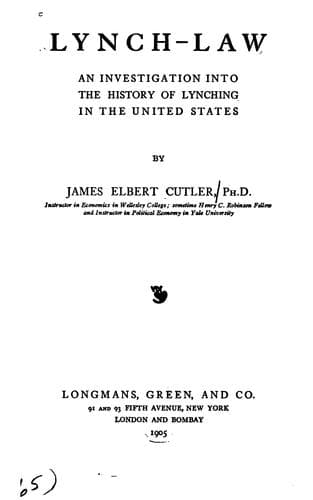
Lynch-law; an investigation into the history of lynching in the United StatesCutler, James Elbert
Philosophy
Lynch-law; an investigation into the history of lynching in the United States
Cutler, James Elbert
Lynching -- United States
against such slave, and his or her defence, and shall proceed to the
examination of witnesses and other evidences, and finally to hear and
determine the matter brought before them, in the most summary and
expeditious manner; and in case the offender shall be convicted of any
crime for which by law the offender ought to suffer death, the said
justices shall give judgment, and award and cause execution of their
sentence to be done, by inflicting such manner of death and at such
time, as the said justices, by and with the consent of the
freeholders, shall direct, and which they shall judge will be most
effectual to deter others from offending in the like manner.
“_And be it further enacted_ by the authority aforesaid, That if any
crime or offence not capital, shall be committed by any slave, such
slave shall be proceeded against and tried for such offence in the
manner hereinbefore directed, by any one justice of the peace and any
two freeholders of the country where the offence shall be committed,
and can be most conveniently assembled; and the said justice and
freeholders shall be assembled, summoned and called together, and
shall proceed upon the trial of any slave who shall commit any offence
not capital, in like manner as is hereinbefore directed for trying of
causes capital. And in case any slave shall be convicted before them
of any offence not capital, the said one justice, by and with the
consent of the said freeholders, shall give judgment for the
inflicting any corporal punishment, not extending to the taking away
life or member, as he and they in their discretion shall think fit,
and shall award and cause execution to be done accordingly. _Provided
always_, that if the said one justice and two freeholders, upon
examination of any slave charged or accused before them for an offence
not capital, shall find the same to be a greater offence, and may
deserve death, they shall, with all convenient speed, summons and
request the assistance of another justice and one or more freeholders,
not exceeding three, which said justice and freeholders newly
assembled, shall join with the justice and freeholders first
assembled, and shall proceed in the trial, and unto final judgment and
execution, if the case shall so require, in manner as is hereinbefore
directed for the trial of capital offences.
Public-domain text, read in full here on John Shaqi.
Reviews
Reviews
No reviews yet
Be the first to share your thoughts on this work.
Elsewhere in the archive
Join the Discussion
Join the discussion
Sign in to leave a comment or review.
Sign InorCreate an account