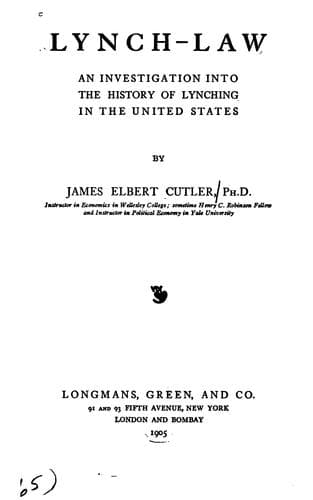
Lynch-law; an investigation into the history of lynching in the United StatesCutler, James Elbert
Philosophy
Lynch-law; an investigation into the history of lynching in the United States
Cutler, James Elbert
Lynching -- United States
“_And be it further enacted_ by the authority aforesaid, That two
justices and one freeholder, or one justice and two freeholders, of
the said two justices and three freeholders, shall make a quorum, and
the conviction or acquittal of any slave or slaves by such a quorum of
them shall be final in all capital cases; but on the trial of slaves
for offences not capital, it shall and may be sufficient if before
sentence or judgment shall be given for inflicting a corporal
punishment, not extending to life or member, that one justice and any
one of the freeholders shall agree that the slave accused is guilty of
the offence with which he shall be charged....
“And _whereas_, slaves may be harbored and encouraged to commit
offences, and concealed and received by free negroes, and such free
negroes may escape the punishment due to their crimes, for want of
sufficient and legal evidence against them; _Be it therefore further
enacted_ by the authority aforesaid, That the evidence of any free
Indian or slave, without oath, shall in like manner be allowed and
admitted in all cases against any free negroes, Indians (free Indians
in amity with this government, only excepted,) mulattoe or mustizoe;
and all crimes and offences committed by free negroes, Indians,
(except as before excepted,) mulattoes or mustizoes, shall be
proceeded in, heard, tried, adjudged and determined by the justices
and freeholders appointed by this Act for the trial of slaves, in like
manner, order and form, as is hereby directed and appointed for the
proceedings and trial of crimes and offences committed by slaves; any
law, statute, usage or custom to the contrary notwithstanding.”[264]
Few of the other colonies made such careful and comprehensive provision
for expediting the trial of slaves, whether accused of minor or of
capital offenses. A number of the other colonies, however, made similar
provision for the prompt trial of slaves and followed the same general
principles in their legislation affecting the punishment of offenses
committed by slaves.[265] Indeed, it was generally true throughout the
period of slavery that a special form of trial was provided in the case
of slaves accused of serious offenses, and that special penalties were
imposed upon such offenders. It is to be noted in the South Carolina Act
of 1740 that free negroes were given the same form of trial as the
slaves, and that the whole purport and spirit of the statute was merely
that justice might be done.
Public-domain text, read in full here on John Shaqi.
Reviews
Reviews
No reviews yet
Be the first to share your thoughts on this work.
Elsewhere in the archive
Join the Discussion
Join the discussion
Sign in to leave a comment or review.
Sign InorCreate an account