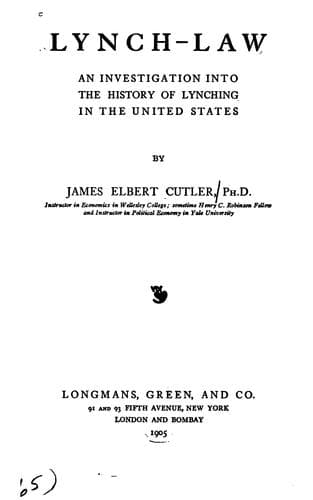
Lynch-law; an investigation into the history of lynching in the United StatesCutler, James Elbert
Philosophy
Lynch-law; an investigation into the history of lynching in the United States
Cutler, James Elbert
Lynching -- United States
On January 6, 1897, Lawrence Brown, colored, was lynched in Orangeburg
County, South Carolina, for suspected arson. Isaac Brown, administrator
of the estate of Lawrence Brown, deceased, entered suit against
Orangeburg County in the common pleas circuit court of that county for
the recovery of damages under Section 6, Article 6, of the constitution,
and the act to prevent lynching which was passed in 1896.[301] Judgment
was rendered for the defendant, the presiding judge directing the jury
to find a verdict in his favor, on the ground that the provision in the
constitution and the act of the legislature conferred upon the plaintiff
no right to recover damages against the defendant, as the person lynched
was not a prisoner. An appeal from this decision was taken to the
supreme court where the judgment of the lower court was reversed and the
case was remanded for trial. The supreme court, construing the
constitutional provision broadly and in connection with the act of the
legislature, ruled that the judge had been in error in his directions to
the jury, that the correct construction of the constitutional provision
made a county liable for damages when the person lynched was not in the
custody of the law as a prisoner. While the court declared a
consideration of the question of the power of the legislature to pass
such an act, independently of the constitutional provision, to be
unnecessary in the case in hand, an opinion in regard to the matter was
expressed in the following words: “It has been held that statutes making
a community liable for damages in cases of lynchings, and giving a right
of recovery to the legal representatives of the person lynched, are
valid, on the ground that the main purpose is to impose a penalty on the
community, which is given to the legal representatives, not because they
have been damaged, but because the legislature sees fit thus to dispose
of the penalty. Such statutes are salutary, as their effect is to render
protection to human life, and make communities law-abiding.”[302]
Public-domain text, read in full here on John Shaqi.
Reviews
Reviews
No reviews yet
Be the first to share your thoughts on this work.
Elsewhere in the archive
Join the Discussion
Join the discussion
Sign in to leave a comment or review.
Sign InorCreate an account