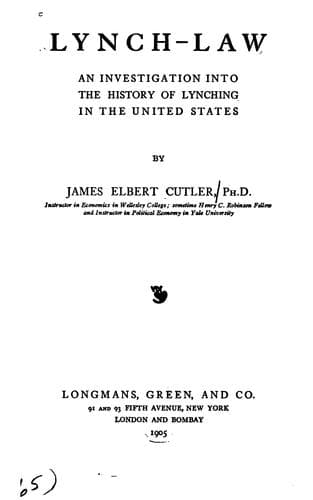
Lynch-law; an investigation into the history of lynching in the United StatesCutler, James Elbert
Philosophy
Lynch-law; an investigation into the history of lynching in the United States
Cutler, James Elbert
Lynching -- United States
In Europe, where the statutes have grown up from tradition and ancient
custom, the law is regarded as a more sacred institution; in a very real
sense it is the product of a superior authority. Law in its
institutional sense is as much a predetermined factor in daily affairs
as is one of the laws of nature. Social and political conditions are
fixed. Politics do not enter into the enforcement of law. Civilization
is distributed in a more nearly equal measure and the law is enforced
with equal vigor over the whole country.[341] The judicial and
administrative officers are persons socially and politically distinct
from the masses, and their individuality is so completely subordinated
to their representative capacity that the law thus comes to have a
majesty and dignity which can be given it in no other way.
In the United States, on the contrary, the body of the law lacks the
support of long tradition and ancient practice. The early immigrants
brought with them the European conception of law, but in the midst of
new conditions, with no strong government to enforce it with an
impartial and an iron hand, along with the growth of the democratic
spirit, a new _esprit des lois_, as Montesquieu would call it, has been
developed. Where the people, either directly or through their
representatives, make the laws and then elect the officers who are to
enforce them, it is inevitable that the legal machinery will prove
powerless to control popular excitements. Politics also enter very
largely into the whole question. In remote districts, too, the people
seldom have occasion to meet any other officers of the law than their
own neighbors and friends whom they have elected to minor civil offices.
It is for this reason that the execution of the law varies so greatly in
different parts of the United States, being either vigorous or lax, in
accordance with the moral sentiment of the community.
In a monarchy or a highly centralized form of government, the law is
made for the people and enforced against them by officials who are in no
sense responsible to them.
In a democracy with a republican form of government, like the United
States, such is not the case. The people consider themselves a law unto
themselves. They make the laws; therefore they can unmake them. Since
they say what a judge can do, they entertain the idea that they may do
this thing themselves. To execute a criminal deserving of death is to
act merely in their sovereign capacity, temporarily dispensing with
their agents, the legal administrators of the law. While not always
expressed in language so unmistakable in meaning, yet this is the spirit
exhibited, the vague and perhaps unconscious attitude toward the law,
which seems particularly to pervade the United States.
Public-domain text, read in full here on John Shaqi.
Reviews
Reviews
No reviews yet
Be the first to share your thoughts on this work.
Elsewhere in the archive
Join the Discussion
Join the discussion
Sign in to leave a comment or review.
Sign InorCreate an account