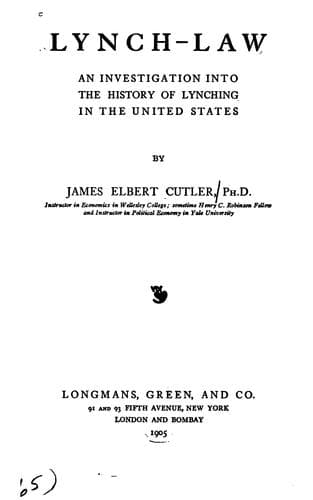
Lynch-law; an investigation into the history of lynching in the United StatesCutler, James Elbert
Philosophy
Lynch-law; an investigation into the history of lynching in the United States
Cutler, James Elbert
Lynching -- United States
The tendency toward public disorder has existed in this country from its
earliest settlement, and as the line of the frontier has slowly moved
westward there has always been a region on the border where the forces
of law were unorganized. There has thus been a constant opportunity for
a plea of necessity in certain cases for resorting to the popular
execution of justice. In recent years the customary explanations of
lynchings attribute them to mob rule, emotional insanity of the crowd,
race prejudice, contempt for the “niggers,” intense community feeling,
vivid hatred of crime, _lex talionis_ and the like. It is often asserted
that lynchings occur because the courts are slow, uncertain, and unduly
sympathetic with the rights of the accused, because corrupt jurymen,
shrewd lawyers, the technicalities of the law or the undue sympathies of
the pardoning powers frequently prolong and save a guilty person’s life.
While it is true on psychological grounds that punishment to be
effective must be prompt and certain, and while such explanations have
validity in particular cases, the fundamental explanation lies deeper.
It is to be found in the peculiar and distinctively American attitude
toward those institutions connoted by the term “the law.”[342] There is
a readiness on the part of the people in the United States to take the
law into their own hands which is not found in other countries, and the
consequent immunity from punishment which is generally accorded to
lynchers renders an American mob exceedingly open to the suggestion of
lynching.
It is on such grounds that the existence of lynching as a peculiarly
American institution is to be explained. Such are the conditions and
such has been the conception of the law which has fostered a public
sentiment in the United States excusing and apologizing for lynchings.
The writer of a book published in London in 1837 was not far wrong when
he wrote: “The Lynch law, is not, properly speaking, an opposition to
the established laws of the country, or, is at least, not contemplated
as such by its adherents; but rather as a supplement to them,—a species
of _common_ law, which is as old as the country.”[343]
Public-domain text, read in full here on John Shaqi.
Reviews
Reviews
No reviews yet
Be the first to share your thoughts on this work.
Elsewhere in the archive
Join the Discussion
Join the discussion
Sign in to leave a comment or review.
Sign InorCreate an account