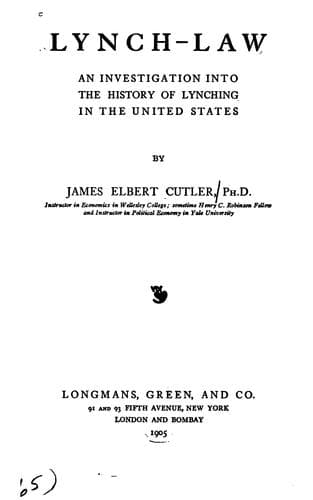
Lynch-law; an investigation into the history of lynching in the United StatesCutler, James Elbert
Philosophy
Lynch-law; an investigation into the history of lynching in the United States
Cutler, James Elbert
Lynching -- United States
For years Charles followed his mother’s teachings and was an active
member of the Society of Friends; for some time he was “Clerk of the
monthly meetings.” Later, however, the exigencies of the times caused
him to forego some of his scruples and accept public office. In 1767
he became “unsatisfactory” to the peace-loving Quakers and he was
“disowned for taking solemn oaths, contrary to the order and
discipline of Friends.” It was in this year, 1767, that he was elected
to the Virginia House of Burgesses, where he held a seat till the
colony became an independent State. He was prominent in the earliest
organization of Bedford County, formed from Lunenburg County in 1753
(Henry Howe: “Historical Collections of Virginia” (1845), p. 188;
Hening’s Statutes at Large, VI, 381), and was a member of the Virginia
convention of 1776, which, by sending instructions to the delegates
from Virginia in the Continental Congress, exercised a decisive
influence on the movement for independence. He had been made a justice
of the peace under a commission from Governor Dunmore in 1774, and
when the county court was reorganized, according to the ordinance of
the Convention, passed on the 3d of July, 1776, he retained the
position.
At the beginning of the Revolutionary War his Quaker principles seemed
still to influence his actions to an extent sufficient to keep him out
of active military service. His loyalty was well known, however. Mr.
Page says: “He did not enlist in the army, partly because of his
Quaker principles, but chiefly because his presence was imperatively
necessary at home. He had to rouse the spirit of his constituents to
support the action he had advocated in the convention. He had to raise
and equip troops for the army. He had, as it were, to mobilize the
forces of his country, and attend to all the duties of a commissary
department. In addition, he had to make some provision in the event of
an attack from hostile Indians.” In 1778 the court of Bedford
recommended him to the Governor for the office of Colonel of Militia
in that county. He accepted the commission and organized a regiment,
but the call to the front did not come till two years later when the
war was shifted to the south and Lord Cornwallis was sent to
co-operate with General Philips and Benedict Arnold in the invasion of
Virginia.
Public-domain text, read in full here on John Shaqi.
Reviews
Reviews
No reviews yet
Be the first to share your thoughts on this work.
Elsewhere in the archive
Join the Discussion
Join the discussion
Sign in to leave a comment or review.
Sign InorCreate an account