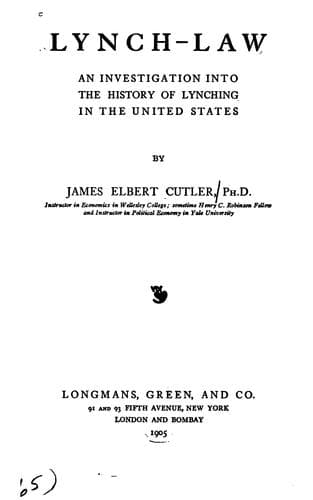
Lynch-law; an investigation into the history of lynching in the United StatesCutler, James Elbert
Philosophy
Lynch-law; an investigation into the history of lynching in the United States
Cutler, James Elbert
Lynching -- United States
The records of the court of Bedford County, the minutes of various
Quaker meetings, the journals of the Virginia House of Burgesses and
of the first Constitutional Convention, taken together with family
documents and traditions, show Charles Lynch to have been a thoroughly
capable and highly respected man, a leader among the men in his
community. Before the close of the war he made a record for himself as
an officer in the army. At the battle of Guilford Court House, March
15, 1781, a battalion of riflemen under his command behaved with much
gallantry and aided in bringing considerable credit to the Virginia
militia. [Henry Howe: “Historical Collections of Virginia” (1845), p.
212. W. G. Simms: “Life of Nathanael Greene” (1859), p. 186. Henry
Lee: “Memoirs of the War” (1812), I, 341, 345. William Johnson:
“Sketches of Life and Correspondence of Nathanael Greene” (1822), II,
3. Banastre Tarleton: “History of the Campaigns of 1780 and 1781”
(1787), p. 272. C. Stedman: “History of the American War” (1794), II,
338.]
He lived for a number of years after peace had been declared with
England, and voted for the new constitution. In the family
burying-ground on his homestead plantation a tombstone bears the
simple inscription:
“In memory of Colonel Charles Lynch, a zealous and active patriot.
Died, October 29, 1796; aged 60 years.”
Many anecdotes are still in circulation among the old inhabitants of
his neighborhood illustrative of his habits and character. The chorus
of a once popular patriotic song runs as follows:
“Hurrah for Colonel Lynch,
Captain Bob and Callaway!
They never turned a Tory loose
Until he shouted ‘Liberty’!”
Another version of this refrain runs this way:
“Hurrah for Captain Bob,
Colonels Lynch and Callaway!
Who never let a Tory off
Until he cried out ‘Liberty!’”
Footnote 41:
Public-domain text, read in full here on John Shaqi.
Reviews
Reviews
No reviews yet
Be the first to share your thoughts on this work.
Elsewhere in the archive
Join the Discussion
Join the discussion
Sign in to leave a comment or review.
Sign InorCreate an account