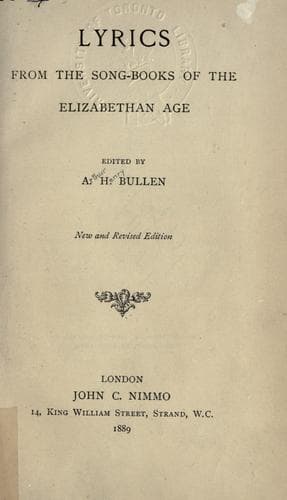
Ballads, English -- Texts; English poetry -- Early modern, 1500-1700; Songs, English -- England -- Texts
There is artful ease and the touch of a poet's hand in those verses; but
the Muses shield us from such innovations! Campion's second collection,
"Two Books of Airs," is undated; but, from an allusion to the death of
Prince Henry, we may conclude that it was published about the year 1613.
The first book consists of "Divine and Moral Songs" and the second of
"light conceits of lovers." In dealing with sacred themes, particularly
when they venture on paraphrases of the Psalms, our poets seldom do
themselves justice; but I claim for Campion that he is neither stiff nor
awkward. Henry Vaughan is the one English poet whose devotional fervour
found the highest lyrical expression; and Campion's impassioned poem
"Awake, awake, thou heavy sprite!" (p. 6) is not unworthy of the great
Silurist. Among the sacred verses are some lines ("Jack and Joan they
think no ill," p. 61) in praise of a contented countryman and his good
wife. A sweeter example of an old pastoral lyric could nowhere be found,
not even in the pages of Nicholas Breton. The "Third and Fourth Books of
Airs" are also undated, but they were probably published in 1613. In
this collection, where all is good, my favourite is "Now winter nights
enlarge" (p. 90). Others may prefer the melodious serenade, worthy even
of Shelley, "Shall I come, sweet love, to thee" (p. 100). But there is
one poem of Campion (printed in the collection of 1601) which, for
strange richness of romantic beauty, could hardly be matched outside the
sonnets of Shakespeare:--
"When thou must home to shades of underground,
And there arrived, a new admired guest,
The beauteous spirits do engirt thee round,
White Iope, blithe Helen, and the rest,
To hear the stories of thy finish'd love
From that smooth tongue whose music hell can move:
Then wilt thou speak of banqueting delights,
Of masques and revels which sweet youth did make,
Of tourneys and great challenges of knights,
And all these triumphs for thy beauty sake:
When thou hast told these honours done to thee,
Then tell, O tell, how thou didst murder me!"
The mention of "White Iope" was suggested by a passage of Propertius:--
"Sunt apud infernos tot millia formosarum;
Pulchra sit, in superis, si licet, una locis.
Vobiscum[2] est _Iope_, vobiscum candida Tyro," &c.
Campion was steeped in classical feeling: his rendering of Catullus'
"Vivamus, mea Lesbia, atque amemus" (p. 80) is, so far as it goes,
delightful. It is time that Campion should again take his rightful place
among the lyric poets of England. In his own day his fame stood high.
Camden did not hesitate to couple his name with the names of Spenser and
Sidney; but modern critics have persistently neglected him. The present
anthology contains a large number of his best poems; and I venture to
hope that my attempt to recall attention to the claims of this true poet
will not be fruitless.
Public-domain text, read in full here on John Shaqi.
Reviews
Reviews
No reviews yet
Be the first to share your thoughts on this work.
Join the Discussion
Join the discussion
Sign in to leave a comment or review.
Sign InorCreate an account