Lyrics from the Song-Books of the Elizabethan Age — John Shaqi
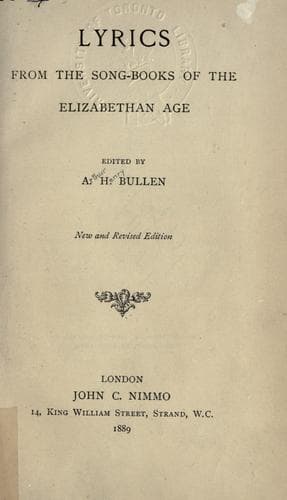
Lyrics from the Song-Books of the Elizabethan Age
General
Lyrics from the Song-Books of the Elizabethan Age
Ballads, English -- Texts; English poetry -- Early modern, 1500-1700; Songs, English -- England -- Texts
There is much excellent verse hidden away in the Song-books of Robert
Jones, a famous performer on the lute. Between 1601 and 1611 Jones
issued six musical works. Two of these--"The First Set of Madrigals,"
1607, and "The Muses' Garden for Delight," 1611,--I have unfortunately
not been able to see, as I have not yet succeeded in discovering their
present resting-place. Of "Ultimum Vale, or the Third Book of Airs"
[1608], only one copy is known. It formerly belonged to Rimbault, and is
now preserved in the library of the Royal College of Music. The other
publications of Jones are of the highest rarity. By turns the songs are
grave and gay. On one page is the warning to Love--
"Little boy, pretty knave, hence, I beseech you!
For if you hit me, knave, in faith I'll breech you." (p. 72.)
On another we read "Love winged my hopes and taught me how to fly," (p.
73); but the vain hopes, seeking to woo the sun's fair light, were
scorched with fire and drown'd in woe,
"And none but Love their woeful hap did rue,
For Love did know that their desires were true;
Though Fate frowned.
And now drowned
They in sorrow dwell,
It was the purest light of heaven for whose fair love they fell."
The last line is superb.
I have drawn freely from the madrigals of Weelkes, Morley, Farmer,
Wilbye and others. Thomas Ford's "Music of Sundry Kinds," 1607, has
yielded some very choice verse; and Francis Pilkington's collections
have not been consulted in vain. From John Attye's "First Book of Airs,"
1622, I have selected one song, (p. 94), only one,--warm and tender and
delicious. Some pleasant verses have been drawn from the rare song-books
of William Corkine; and Thomas Vautor's "Songs of Divers Airs and
Natures," 1619, have supplied some quaint snatches, notably the address
to the owl, (p. 116) "Sweet Suffolk owl, so trimly dight." I have
purposely refrained from giving many humorous ditties. Had I been
otherwise minded there was plenty of material to my hand in the
rollicking rounds and catches of Ravenscroft's admirable collections.
As I have no technical knowledge of the subject, it would be impertinent
for me to attempt to estimate the merits of the music contained in these
old song-books; but I venture with all confidence to commend the poetry
to the reader's attention. There is one poem which I have deliberately
kept back. It occurs in "The First Part of Airs, French, Polish, and
others together, some in tableture and some in prick-song," 1605. The
composer was a certain Captain Tobias Hume, but who the author of the
poem was I know not. Here is the first stanza:--
"Fain would I change that note
To which fond love hath charm'd me,
Long long to sing by rote,
Fancying that that harm'd me:
Yet when this thought doth come,
'Love is the perfect sum
Of all delight,'
I have no other choice
Either for pen or voice
To sing or write."
Public-domain text, read in full here on John Shaqi.
Reviews
Reviews
No reviews yet
Be the first to share your thoughts on this work.
Join the Discussion
Join the discussion
Sign in to leave a comment or review.
Sign InorCreate an account