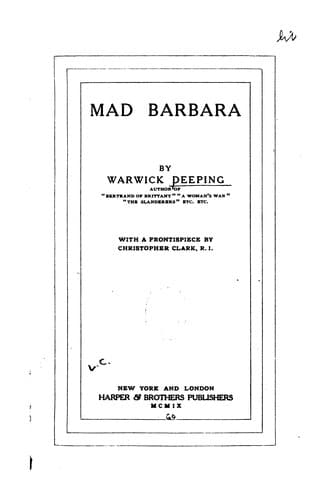
Great Britain -- History -- Charles II, 1660-1685 -- Fiction
Barbara had not gone ten steps before she heard a slight sound behind
her like the rustle of a skirt. Startled though she may have been, she
betrayed nothing, but moved on with every sense alert. That some one was
close behind her she felt assured. Her hand was on the latch of her
mother’s door before her suspicions began to be confirmed.
She pushed the door open and crossed the threshold; yet though the room
was in utter darkness, she felt instinctively that it was empty. Turning
slowly so that she faced the door, she saw the outline of a figure
framed there against the dim glow of the moonlight that filled the
gallery.
Barbara stood motionless awhile, making no sign or sound, and then
walked straight toward the door. The figure faltered a moment before
gliding aside. Barbara passed it, her eyes fixed as on some dreamy
distance, her face blank and expressionless, her step unhurried. As she
passed back along the gallery she felt that the figure was following
her, and knew that it was a woman, and that woman Mrs. Jael.
Still statuesque as one walking in her sleep she re-entered her room,
closed the door, locked it, and moved toward the window. She stood there
a moment, motionless, and if she saw anything in the garden beneath her
she betrayed no feeling and no conscious life. Before the clocks had
chimed the half-hour she was in her bed again, but not to sleep.
By the door leading into the garden two shadowy figures were whispering
together.
“She was asleep?”
“Yes, my lady.”
“Are you sure?”
“She walked past me as though I was not there. I have seen such a thing
before, yet it gave me a fright.”
“And she went to my room, Jael?”
“It was as dark as a cupboard, my lady. No one could have told that it
was empty—even if they had been awake.”
The sky was a brave blue next morning, and the air full of the scent of
summer when Barbara came down to the little parlor that looked out on
the garden. Her air of lethargy had a touch of gentleness to soften it.
Anne Purcell was already at the table. A plate of cherries and a flask
of red wine added color to the prosaic usefulness of pie and bacon.
Anne Purcell glanced at her daughter with momentary and questioning
distrust. The girl’s face betrayed no more self-consciousness than the
great white loaf on the trencher near her mother. She sat down, glanced
over the table listlessly, and then through the window where the sun was
shining.
“You look tired, Barbe?”
An insinuating friendliness approached her in the mother’s voice.
“Tired?—I slept all night. How fresh the garden looks! I feel I should
like a drive in the park to-day.”
“Yes; you want more interest—more bustle in your life.”
“Perhaps I should have fewer moods—”
“Take some wine, dear,” and she pushed the flask toward her. “Why not
trust yourself to me a little more? We are not all so melancholy.”
“I might only spoil your pleasure.”
“Nonsense. I should enjoy life more if you had a happier face.”
Public-domain text, read in full here on John Shaqi.
Reviews
Reviews
No reviews yet
Be the first to share your thoughts on this work.
Join the Discussion
Join the discussion
Sign in to leave a comment or review.
Sign InorCreate an account