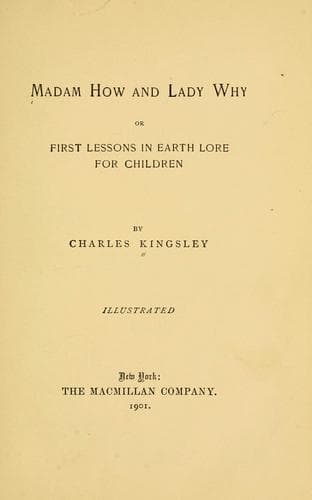
Madam How and Lady Why; Or, First Lessons in Earth Lore for ChildrenKingsley, Charles
History
Madam How and Lady Why; Or, First Lessons in Earth Lore for Children
Kingsley, Charles
Geology -- Juvenile literature; Natural history -- Juvenile literature
We do not know. No more do we know how it comes to pass that this thin
band (often only a few inches thick) of dead creatures should stretch all
the way from Dorsetshire to Norfolk, and, I believe, up through
Lincolnshire. And what is stranger still, this same bone-earth bed crops
out on the south side of the chalk at Farnham, and stretches along the
foot of those downs, right into Kent, making the richest hop lands in
England, through Surrey, and away to Tunbridge. So that it seems as if
the bed lay under the chalk everywhere, if once we could get down to it.
But how does it make the hop lands so rich?
Because hops, like tobacco and vines, take more phosphorus out of the
soil than any other plants which we grow in England; and it is the
washings of this bone-earth bed which make the lower lands in Farnham so
unusually rich, that in some of them--the garden, for instance, under the
Bishop's castle--have grown hops without resting, I believe, for three
hundred years.
But who found out all this about the Coprolites?
Ah--I will tell you; and show you how scientific men, whom ignorant
people sometimes laugh at as dreamers, and mere pickers up of useless
weeds and old stones, may do real service to their country and their
countrymen, as I hope you will some day.
There was a clergyman named Henslow, now with God, honoured by all
scientific men, a kind friend and teacher of mine, loved by every little
child in his parish. His calling was botany: but he knew something of
geology. And some of these Coprolites were brought him as curiosities,
because they had fossils in them. But he (so the tale goes) had the wit
to see that they were not, like other fossils, carbonate of lime, but
phosphate of lime--bone earth. Whereon he told the neighbouring farmers
that they had a mine of wealth opened to them, if they would but use them
for manure. And after a while he was listened to. Then others began to
find them in the Eastern counties; and then another man, as learned and
wise as he was good and noble--John Paine of Farnham, also now with
God--found them on his own estate, and made much use and much money of
them: and now tens of thousands of pounds' worth of valuable manure are
made out of them every year, in Cambridgeshire and Bedfordshire, by
digging them out of land which was till lately only used for common
farmers' crops.
But how do they turn Coprolites into manure? I used to see them in the
railway trucks at Cambridge, and they were all like what I have at
home--hard pebbles.
They grind them first in a mill. Then they mix them with sulphuric acid
and water, and that melts them down, and parts them into two things. One
is sulphate of lime (gypsum, as it is commonly called), and which will
not dissolve in water, and is of little use. But the other is what is
called superphosphate of lime, which will dissolve in water; so that the
roots of the plants can suck it up: and that is one of the richest of
manures.
Public-domain text, read in full here on John Shaqi.
Reviews
Reviews
No reviews yet
Be the first to share your thoughts on this work.
Elsewhere in the archive
Join the Discussion
Join the discussion
Sign in to leave a comment or review.
Sign InorCreate an account