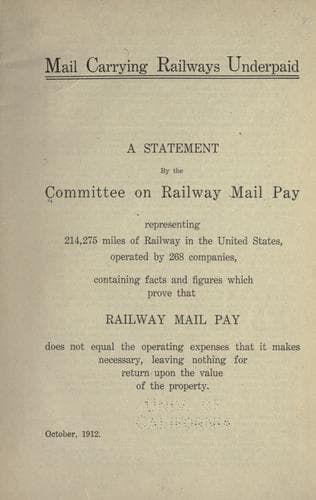
Mail Carrying Railways UnderpaidCommittee on Railway Mail Pay
History
Mail Carrying Railways Underpaid
Committee on Railway Mail Pay
Railway mail service -- United States
This examination of his methods shows that the determination of space
was of primary and controlling importance and that the changes in
space allotment have destroyed the value of his deductions. These
changes were due to his refusal to assign to the mail service the
working space and temporarily unoccupied space on trains, which were
necessary to the mail service and to his actually assigning much of
this space to the passenger service rendered on the same trains.
It is scarcely necessary to note that all kinds of traffic require
"working space" in addition to the space actually occupied by the
traffic itself, and that this is especially true of the mail traffic,
or that where there is a preponderating movement of a certain traffic
in one direction there must be some empty space on account of that
traffic, sometimes called "dead" space, in trains moving in the
direction of lighter traffic. Thus passenger cars must have aisles,
vestibules and platforms, and postal cars must have a great deal of
space in which to sort the mails while, for mail carried in baggage
cars, there must be space in which to reach the pouches and to receive
and deliver them through the doors. A through train must also have the
full capacity required for the maximum traffic of any kind likely to
seek accommodation on any part of its journey, although during much of
each trip the actual traffic may be considerably below this limit. The
Postmaster-General, however, refused to credit the mail service with
much of the space thus required by the Department although his figures
for the other passenger train services allowed fully for all such
space required by them. In fact in many cases such space, actually
required by the mails and so reported by the railways, was taken from
the total mail space and, without reason, assigned to the passenger
service. These modifications of the data correctly reported, not
susceptible of justification upon any sound transportation principle,
were carried so far that the tabulations of the Post Office
Department, which are stated for railway mail routes having a total
length of 194,977.55 miles[E] show only 926,164,459 "car-foot miles"
made in the mail service, although certain railways, included therein,
and having railway mail routes aggregating only 178,709.96 miles, had
correctly reported mail space equivalent to 1,153,110,245 "car-foot
miles." Thus, although the Department's figures cover 8.3 per cent.
more mileage, its reductions of space resulted in assigning to this
greater mileage about one-quarter (24.5 per cent.) less mail space. At
the same time the Department actually increased the space assigned to
the other passenger train services, its figures showing 12,014,065,506
car-foot miles in these services for 194,977.55 miles of mail routes
which must be compared with 11,222,478,739 car-foot miles reported by
the railways for 178,709.96 mail-route miles.
[Footnote E: Document No. 105, p. 53.]
Public-domain text, read in full here on John Shaqi.
Reviews
Reviews
No reviews yet
Be the first to share your thoughts on this work.
Join the Discussion
Join the discussion
Sign in to leave a comment or review.
Sign InorCreate an account