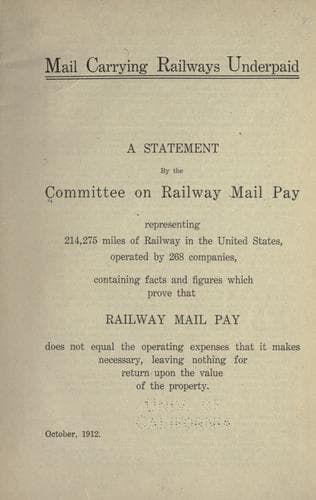
Mail Carrying Railways UnderpaidCommittee on Railway Mail Pay
History
Mail Carrying Railways Underpaid
Committee on Railway Mail Pay
Railway mail service -- United States
All the foregoing data were reported to the Postmaster-General in
response to his request but he made no use of these items, an omission
manifestly to the serious disadvantage of the railways and having the
effect of unduly reducing his estimates of the cost of the mail
service.
Similarly, the Postmaster-General omitted to use the data he had
obtained from the railways showing the volume of free passenger
transportation, already referred to, supplied to the officers and
agents of the Post Office Department and his estimates contain no
recognition of the cost of this service although its extent should be
a matter of record in the Department as it is furnished only on its
requisition. The space in passenger coaches occupied by these
representatives of the Post Office Department, traveling free, was not
assigned to the mail service but was treated as passenger space.
VII. THE MONTH OF NOVEMBER IS NOT A FAIR AVERAGE MONTH IN ANY RAILWAY
YEAR OR ONE THAT IS TYPICAL OF A YEAR'S BUSINESS AND ITS USE AS THE
SOLE BASIS OF THE POSTMASTER-GENERAL'S CALCULATIONS WAS SO UNFAVORABLE
TO THE RAILWAYS AS TO DEPRIVE THE RESULTS OF ANY VALUE EVEN IF IN ALL
OTHER RESPECTS HIS METHODS WERE BEYOND CRITICISM.
All the Postmaster-General's calculations, reported in Document No.
105, and by him relied upon therein, and elsewhere, to substantiate
his attack upon existing railway mail pay, depend solely upon data for
the single month of November, in the year 1909. It is obvious,
therefore, that the validity of his conclusions, if all the rest of
his processes were accurate and his deductions otherwise sound, would
depend upon whether November is sufficiently typical of the railway
year to be safely used as the sole basis for conclusions applicable to
a whole year. The truth is, however, that November is not a typical or
average month and that all of its deviations from the averages
of the year are such as greatly to favor the result which the
Postmaster-General was seeking.
It may well be doubted whether the railway year contains any month
that can properly be regarded as typical of the whole period but if it
does, the month of November, with four Sundays, two holidays and only
twenty-four working days, is certainly not such a month. The
Interstate Commerce Commission publishes the monthly aggregates of
railway receipts and these official data conclusively prove that
November, 1909, was the one month for which the data were most
strongly favorable to finding, by the Postmaster-General's method, an
abnormally low apparent cost for the passenger train services and,
consequently, for the mail service.
Public-domain text, read in full here on John Shaqi.
Reviews
Reviews
No reviews yet
Be the first to share your thoughts on this work.
Join the Discussion
Join the discussion
Sign in to leave a comment or review.
Sign InorCreate an account