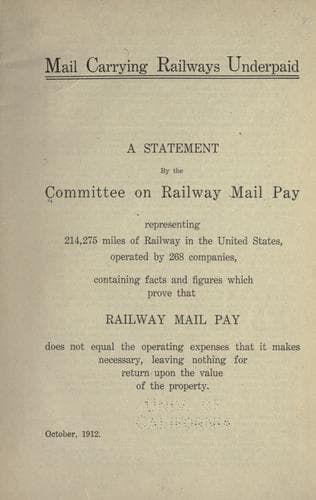
Mail Carrying Railways UnderpaidCommittee on Railway Mail Pay
History
Mail Carrying Railways Underpaid
Committee on Railway Mail Pay
Railway mail service -- United States
During the ten years from 1901 to 1911 the Department took up an
enormous increase in business at a greatly decreased cost for railway
transportation and at a largely increased cost for other purposes. It
cost the Department, for purposes other than railway transportation,
nearly nine-tenths of $126,248,630 to add that amount to its gross
receipts (although for these other purposes it had previously spent
less than seven-tenths of its gross receipts) while it required less
than one-tenth of the same sum to pay for the added railway
transportation that the new business required (although at the
beginning of the period railway transportation had cost more than
one-third of the gross receipts). This startling comparison fully
warrants the conclusion that the power of Congress and the Department
has been exercised to force upon the railways, by reducing the
payments for their services, the burden not only of the effort to
eliminate the annual postal deficit but of considerable increases in
other forms of postal expenditure. No reference to rural free delivery
will serve to explain away the conclusion suggested by this comparison
especially since only a fraction of the cost of that service
represents really an additional net outlay. This service has permitted
a reduction of one-third in the number of post offices and has been in
many cases substituted for star route service and the savings thus
permitted ought to be credited to it before determining its cost.
That increases in postal expenditures were necessary, between 1901 and
1911, is not denied. The period was one in which steady and extensive
increases in the cost of living made necessary considerable increases
in the salaries of postal employees and in the cost of postal
supplies, precisely as the railways were impelled to increase the
salaries and wages of their employees and were obliged to pay higher
prices for their supplies. In other words, the purchasing power of the
American dollar, and of standard money everywhere, greatly decreased
and this decrease affected the Post Office Department as it has
affected every business undertaking. But the purchasing power of the
railway dollar decreased exactly as that of all other dollars and it
was unreasonable and unjust that while this change was in progress,
the losses which it entailed in the postal service of the Government
should be shifted, as it has been shown that they were, to the
railways which were, at the same time, suffering far greater losses
from the same cause.
Public-domain text, read in full here on John Shaqi.
Reviews
Reviews
No reviews yet
Be the first to share your thoughts on this work.
Join the Discussion
Join the discussion
Sign in to leave a comment or review.
Sign InorCreate an account