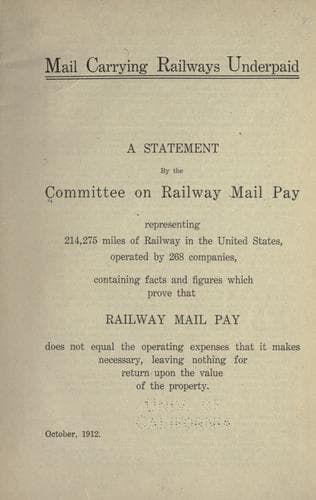
Mail Carrying Railways UnderpaidCommittee on Railway Mail Pay
History
Mail Carrying Railways Underpaid
Committee on Railway Mail Pay
Railway mail service -- United States
X. THE CONTINUOUS REFUSAL OF THE POST OFFICE DEPARTMENT TO ORDER
REWEIGHINGS OF THE MAILS EXCEPT AFTER THE MAXIMUM INTERVAL OF FOUR
YEARS WHICH THE LAW ALLOWS, THE DEMANDS FOR STATION AND TERMINAL
SERVICES THAT ARE RENDERED WITHOUT ANY OR WITHOUT ADEQUATE
COMPENSATION AND THE UNJUST DISCRIMINATION AGAINST COMPARTMENT CARS
USED AS RAILWAY POST OFFICES ARE ALL ABUSES, SERIOUSLY INJURIOUS TO
THE RAILWAYS, WHICH HAVE GROWN UP UNDER THE PRESENT SYSTEM OF PAYMENT
AND OUGHT AT ONCE TO BE REMEDIED.
In addition to the inadequacies in the rates of pay provided under the
present law, which result in payments that do not leave any balance
for taxes or return upon property and indeed do not even meet
operating expenses, there are certain conditions which have grown up
in the application of the existing basis of pay that ought to be
rectified. This is especially necessary in view of the tendency,
herein shown, of the Post Office Department to apply the system so as
to reduce its expense for railway transportation, and to look to this
item as the chief or sole source of economies.
The transportation pay received for each railway route is determined,
under the practice of the Department, for a period of four years on
the basis of the average daily weight carried during a period of about
three months duration prior to the beginning of the period for which
it is fixed. Thus, by the terms of the law, the Government upholds the
principle that weight should be the basis of payment but, by an
inconsistent practice, denies that principle and creates a condition
under which it is practically certain that the weight actually carried
will differ materially from the weight paid for. Congress, surely,
never intended this result for the provision of law is, merely, that
the mail shall be weighed "not less frequently" than once in four
years and clearly implies an intention that it should be weighed
whenever a substantial change in volume has taken place. But the Post
Office Department controls, subject to the provision of law, the
frequency of the weighings, and naturally seeks those reductions in
its expenses which can be effected without loss anywhere except in
railway revenues. Consequently, it long ago ceased to order new
weighings, except when compelled to do so by the expiration of the
statutory limit. It thus happens that while the railways are paid on
the basis of a certain average daily weight they are frequently
carrying a much greater weight and with no compensation whatever for
the increase in the weight. In other instances the change is in the
opposite direction but with increasing national population and wealth
it is obvious that most of these changes must be to the injury of the
railways. However, the element of uncertainty thus introduced into
each contract is unbusinesslike and in fairness to both parties ought
to be removed. No railway would make a four years' contract to carry,
for a definite sum, the unlimited output of any manufacturing plant
Public-domain text, read in full here on John Shaqi.
Reviews
Reviews
No reviews yet
Be the first to share your thoughts on this work.
Join the Discussion
Join the discussion
Sign in to leave a comment or review.
Sign InorCreate an account