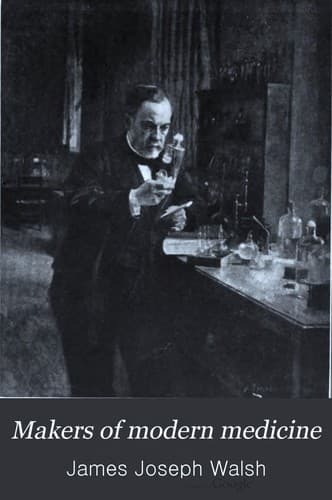
Makers of Modern MedicineWalsh, James J. (James Joseph)
History
Makers of Modern Medicine
Walsh, James J. (James Joseph)
Medicine -- Biography
More than two hundred and fifty years ago, Descartes, the most
original mind of the modern age, who, more than any other thinker,
has determined the course both of speculative and of scientific
inquiry, declared that if any great improvement in the condition of
mankind was to be brought about, medicine would provide the means,
and what he foresaw we see.
--Bishop Spalding.
{293}
PASTEUR, FATHER OF PREVENTIVE MEDICINE.
Louis Pasteur is the most striking figure in nineteenth century
science. In biology, in chemistry, in physics, in medicine and
surgery, and in the important practical subjects of fermentation,
spontaneous generation and sanitation, he has left landmarks that
represent great advances in science and starting-points for new
explorations into the as yet unmapped domain of scientific knowledge.
His was a typically scientific mind. His intuitions were marvellous in
their prophetic accuracy, yet were surpassed by his wonderful faculty
for evolving methods of experimental demonstrations of his theories.
His work has changed the whole aspect of biology and medicine, and
especially the precious branches of it that refer to the cure and
treatment of disease.
To such a man our generation owes a fitting monument. It has been
given him. He was modest in life with the sincere modesty of the true
man of science, who knows in the midst of great discoveries that he is
only on the edge of truth, who realizes that "abyss calls to abyss" in
the world of knowledge that lies beyond his grasp. Pasteur's monument,
very appropriately for a man of his practical bent, is no idle
ornamental memorial. It is a great institution for the perpetual
prosecution of his favorite studies and for the care of patients
suffering from the diseases to whose investigation the best part of
his life was devoted.
In this Institut Pasteur repose his ashes. They find a suitable
resting-place in a beautiful chapel. Situate just below the main
entrance a little lower than the ground floor, {294} of the institute
proper, this chapel seems to form the main part of the foundation of
the building. It is symbolic of the life of the man in whose honor it
was erected. He who said, "The more I know the more nearly does my
faith approach that of the Breton peasant. Could I but know it all my
faith would doubtless equal even that of the Breton peasant woman." On
a firm foundation of imperturbable faith this greatest scientific
genius of the century raised up an edifice of acquisitions to science
such as it had never before been given to man to make.
Above the entrance of this chapel-tomb, and immediately beneath the
words "Here lies Pasteur," is very fittingly placed his famous
confession of faith:
"Happy the man who bears within him a divinity, an ideal of beauty
and obeys it; an ideal of art, an ideal of science, an ideal of
country, an ideal of the virtues of the Gospel." [Footnote 12]
Public-domain text, read in full here on John Shaqi.
Reviews
Reviews
No reviews yet
Be the first to share your thoughts on this work.
Elsewhere in the archive
Join the Discussion
Join the discussion
Sign in to leave a comment or review.
Sign InorCreate an account