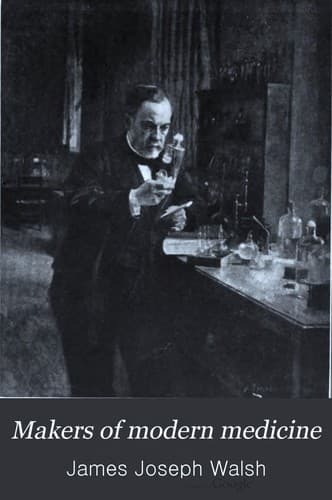
Makers of Modern MedicineWalsh, James J. (James Joseph)
History
Makers of Modern Medicine
Walsh, James J. (James Joseph)
Medicine -- Biography
There is said to exist a constant, unappeasable warfare between
science and religion. Perhaps it does exist, but surely only in the
narrow minds of the lesser lights. In no century has science developed
as in the one that has just closed. Faraday the great scientific mind
of the beginning of the century, said, at one of his lectures before
the Royal Academy of Sciences of England, when the century was
scarcely a decade old: "I do not name God here because I am lecturing
on experimental science. But the notion of respect for God comes to my
mind by ways as sure as those {296} which lead us to physical truth."
At the end of the century the monument of a great man of science is a
chapel with an altar on which the sacrifice of Him that died for men
is commemorated on Pasteur anniversaries.
The walls of the chapel are inscribed with the scientific triumphs of
the master whose ashes repose here. It is a striking catalogue. Each
heading represents a great step forward in science:
1848, Molecular Dissymmetry.
1857, Fermentations.
1862, So-called Spontaneous Generation.
1863, Studies in Wine.
1865, Diseases of Silk Worms.
1871, Studies in Beer.
1877, Virulent Microbic Diseases.
1880, Vaccinating Viruses.
1885, Prophylaxis of Rabies.
Apparently these various subjects are widely separated from one
another. It might seem that Pasteur was an erratic genius. As a matter
of fact, each successive subject follows its predecessor by a rigid
logic. Pasteur's life-work can be best studied by a consideration of
these various topics and an appreciation of the advance made in each
one.
Pasteur was first of all and always a chemist! He was interested in
chemistry from his early years. In the decade from 1840 to 1850
organic chemistry--or as we prefer to call it now, the chemistry of
the carbon compounds--was just opening up. Great discoveries were
possible as they were not before or since. Pasteur, with a devotion to
experimental work that amounted to a passion, was a pupil at the Ecole
Normale, in Paris. Bruited about he heard all the suggestive questions
that were insoluble problems even to the great men around him. He was
especially interested in the burning {297} question of the day, the
internal constitution of molecules and the arrangement of atoms in
substances which, though they are composed of exactly the same
constituents, exhibit very different physical and chemical qualities.
The subject is, almost needless to say, a basic problem in chemistry
and remains to our own day the most attractive of scientific
mysteries.
Public-domain text, read in full here on John Shaqi.
Reviews
Reviews
No reviews yet
Be the first to share your thoughts on this work.
Elsewhere in the archive
Join the Discussion
Join the discussion
Sign in to leave a comment or review.
Sign InorCreate an account