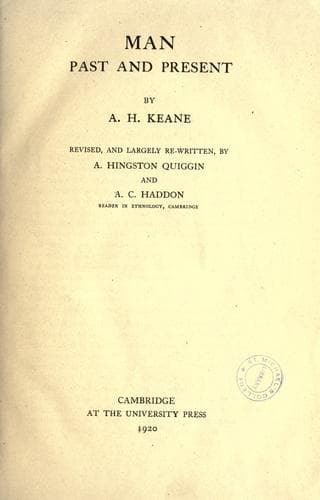
Man, Past and PresentKeane, A. H. (Augustus Henry)
History
Man, Past and Present
Keane, A. H. (Augustus Henry)
Anthropology; Ethnology
Both nations are industrious tillers of the soil, skilled in metal-work
and in mining operations, being probably the direct descendants of the
natives, whose great chief _Monomotapa_, _i.e._ "Lord of the Mines," as
I interpret the word[258], ruled over the Manica and surrounding
auriferous districts when the Portuguese first reached Sofala early in
the sixteenth century. Apparently for political reasons[259] this
Monomotapa was later transformed by them from a monarch to a monarchy,
the vast empire of Monomotapaland, which was supposed to comprise pretty
well everything south of the Zambesi, but, having no existence, has for
the last two hundred years eluded the diligent search of historical
geographers.
But some centuries before the arrival of the Portuguese the Ma-Kalakas
with the kindred Ba-Nyai, Ba-Senga and others, may well have been at
work in the mines of this auriferous region, in the service of the
builders of the Zimbabwe ruins explored and described by the late
Theodore Bent[260], and by him and many others attributed to some
ancient cultured people of South Arabia. This theory of prehistoric
Oriental origin was supported by a calculation of the orientation of the
Zimbabwe "temple," by reports of inscriptions and emblems suggesting
"Phoenician rites," and by the discovery, during excavation, of foreign
objects. Later investigation, however, showed that the orientation was
based on inexact measurements; no authentic inscriptions were found
either at Zimbabwe or elsewhere in connection with the ruins; none of
the objects discovered in the course of the excavations could be
recognised as more than a few centuries old, while those that were not
demonstrably foreign imports were of African type. In 1905 a scientific
exploration of the ruins placed these facts beyond dispute. The
medieval objects were found in such positions as to be necessarily
contemporaneous with the foundation of the buildings, all of which could
be attributed to the same period. Finally it was established that the
plan and construction of Zimbabwe instead of being unique, as was
formerly supposed, only differed from other Rhodesian ruins in
dimensions and extent. The explorers felt confident that the buildings
were not earlier than the fourteenth or fifteenth century A.D., and that
the builders were the Bantu people, remains of whose stone-faced kraals
are found at so many places between the Limpopo and the Zambesi. Their
conclusions, however, have not met with universal acceptance[261].
Public-domain text, read in full here on John Shaqi.
Reviews
Reviews
No reviews yet
Be the first to share your thoughts on this work.
Elsewhere in the archive
Join the Discussion
Join the discussion
Sign in to leave a comment or review.
Sign InorCreate an account