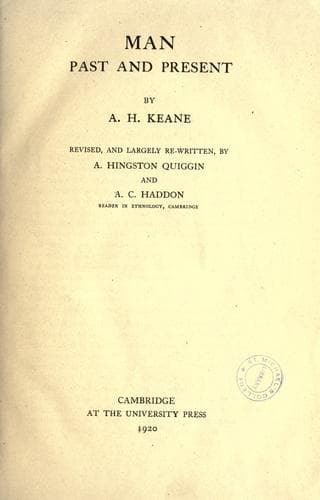
Man, Past and PresentKeane, A. H. (Augustus Henry)
History
Man, Past and Present
Keane, A. H. (Augustus Henry)
Anthropology; Ethnology
With the Be-Chuanas, whose territory extends from the Orange river to
Lake Ngami and includes Basutoland with a great part of the Transvaal,
we again meet a people at the totemic stage of culture. Here the
eponymous heroes of the Zulu-Xosas are replaced by baboons, fishes,
elephants, and other animals from which the various tribal groups claim
descent. The animal in question is called the _siboko_ of the tribe and
is held in especial reverence, members (as a rule) refraining from
killing or eating it. Many tribes take their name from their _siboko_,
thus the Ba-Tlapin, "they of the fish," Ba-Kuena, "they of the
crocodile." The _siboko_ of the Ba-Rolong, who as a tribe are
accomplished smiths, is not an animal, but the metal iron[262].
With a section of the great Be-Chuana family, the Ba-Suto, and the
Ba-Rotse is connected one of the most remarkable episodes in the
turbulent history of the South African peoples during the nineteenth
century. Many years ago an offshoot of the Ba-Rotse migrated to the
Middle Zambesi above the Victoria Falls, where they founded a powerful
state, the "Barotse (Marotse) Empire," which despite a temporary eclipse
still exists as a British protectorate. The eclipse was caused by
another migration northwards of a great body of Ma-Kololo, a branch of
the Ba-Suto, who under the renowned chief Sebituane reached the Zambesi
about 1835 and overthrew the Barotse dynasty, reducing the natives to a
state of servitude.
But after the death of Sebituane's successor, Livingstone's Sekeletu,
the Ba-Rotse, taking advantage of their oppressors' dynastic rivalries,
suddenly revolted, and after exterminating the Ma-Kololo almost to the
last man, reconstituted the empire on a stronger footing than ever. It
now comprises an area of some 250,000 square miles between the Chobe and
the Kafukwe affluents[263], with a population vaguely estimated at over
1,000,000, including the savage Ba-Shukulumbwe tribes of the Kafukwe
basin reduced in 1891[264].
Yet, short as was the Ma-Kololo rule (1835-70), it was long enough to
impose their language on the vanquished Ba-Rotse[265]. Hence the curious
phenomenon now witnessed about the Middle Zambesi, where the Ma-Kololo
have disappeared, while their Sesuto speech remains the common medium of
intercourse throughout the Barotse empire. How often have analogous
shiftings and dislocations taken place in the course of ages in other
parts of the world! And in the light of such lessons how cautious
ethnographists should be in arguing from speech to race, and drawing
conclusions from these or similar surface relations!
Public-domain text, read in full here on John Shaqi.
Reviews
Reviews
No reviews yet
Be the first to share your thoughts on this work.
Elsewhere in the archive
Join the Discussion
Join the discussion
Sign in to leave a comment or review.
Sign InorCreate an account