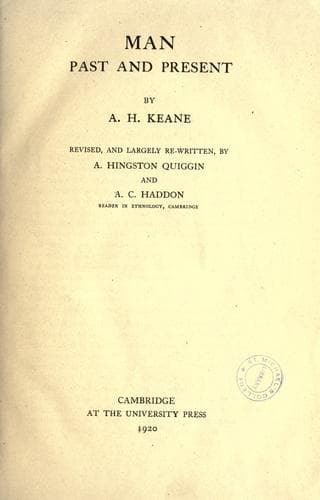
Man, Past and PresentKeane, A. H. (Augustus Henry)
History
Man, Past and Present
Keane, A. H. (Augustus Henry)
Anthropology; Ethnology
But all, both northern Zulus and southern Xosas, are essentially one
people in speech, physique, usages and social institutions. The hair is
uniformly of a somewhat frizzly texture, the colour of a light or clear
brown amongst the Ama-Tembus, but elsewhere very dark, the Swazis being
almost "blue-black"; the head decidedly long (72.5) and high (195.8);
nose variable, both Negroid and perfectly regular; height above the mean
1.75 m. to 1.8 m. (5 ft. 9 in. to 5 ft. 11 in.); figure shapely and
muscular, though Fritsch's measurements show that it is sometimes far
from the almost ideal standard of beauty with which some early observers
have credited them.
Mentally the Zulu-Xosas stand much higher than the true Negro, as shown
especially in their political organisation, which, before the
development of Dingiswayo's military system under European influences,
was a kind of patriarchal monarchy controlled by a powerful aristocracy.
The nation was grouped in tribes connected by the ties of blood and
ruled by the hereditary _inkose_, or feudal chief, who was supreme, with
power of life and death, within his own jurisdiction. Against his
mandates, however, the nobles could protest in council, and it was in
fact their decisions that established precedents and the traditional
code of common law. "This common law is well adapted to a people in a
rude state of society. It holds everyone accused of crime guilty unless
he can prove himself innocent; it makes the head of the family
responsible for the conduct of all its branches, the village
collectively for all resident in it, and the clan for each of its
villages. For the administration of the law there are courts of various
grades, from any of which an appeal may be taken to the Supreme Council,
presided over by the paramount chief, who is not only the ruler but also
the father of the people[257]."
In the interior, between the southern coast ranges and the Zambesi, the
Hottentot and Bushman aborigines were in prehistoric ages almost
everywhere displaced or reduced to servitude by other Bantu peoples such
as the Ma-Kalakas and Ma-Shonas, the Be-Chuanas and the kindred
Ba-Sutos. Of these the first arrivals (from the north) appear to have
been the Ma-Shonas and Ma-Kalakas, who were being slowly "eaten up" by
the Ma-Tabili when the process was arrested by the timely intervention
of the English in Rhodesia.
Public-domain text, read in full here on John Shaqi.
Reviews
Reviews
No reviews yet
Be the first to share your thoughts on this work.
Elsewhere in the archive
Join the Discussion
Join the discussion
Sign in to leave a comment or review.
Sign InorCreate an account