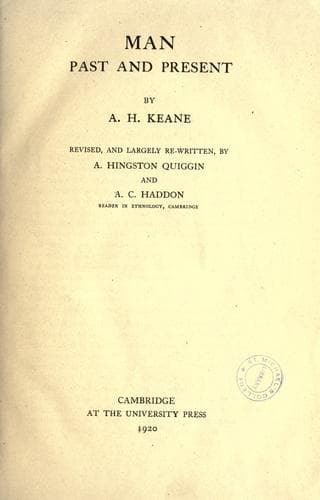
Man, Past and PresentKeane, A. H. (Augustus Henry)
History
Man, Past and Present
Keane, A. H. (Augustus Henry)
Anthropology; Ethnology
[250] W. E. H. Barrett, "Notes on the Customs and Beliefs of the
Wa-Giriama," etc., _Journ. Roy. Anthr. Inst._ XLI. 1911, gives further
details. For a full review of the religious beliefs of Bantu tribes see
E. S. Hartland, Art. "Bantu and S. Africa," _Ency. of Religion and
Ethics_, 1909.
[251] The name still survives in _Zangue-bar_ ("Zang-land") and the
adjacent island of _Zanzibar_ (an Indian corruption). _Zang_ is "black,"
and _bar_ is the same Arabic word, meaning dry land, that we have in
_Mala-bar_ on the opposite side of the Indian Ocean. Cf. also _barran wa
bahran_, "by land and by sea."
[252] _Viage por Malabar y Costas de Africa_, 1512, translated by the
Hon. Henry E. J. Stanley, Hakluyt Society, 1868.
[253] In preference to the more popular form _Zulu-Kafir_, where _Kafir_
is merely the Arabic "Infidel" applied indiscriminately to any people
rejecting Islam; hence the _Siah Posh Kafirs_ ("Black-clad Infidels") of
Afghanistan; the _Kufra_ oasis in the Sahara, where _Kufra_, plural of
_Kafir_, refers to the pagan Tibus of that district; and the Kafirs
generally of the East African seaboard. But according to English usage
_Zulu_ is applied to the northern part of the territory, mainly Zululand
proper and Natal, while Kafirland or Kaffraria is restricted to the
southern section between Natal and the Great Kei River. The bulk of
these southern "Kafirs" belong to the Xosa connection; hence this term
takes the place of _Kafir_, in the compound expression _Zulu-Xosa_.
_Ama_ is explained on p. 86, and the _X_ of _Xosa_ represents an
unpronounceable combination of a guttural and a lateral click, this with
two other clicks (a dental and a palatal) having infected the speech of
these Bantus during their long prehistoric wars with the Hottentots or
Bushmen. See p. 129.
[254] See p. 86 above.
[255] See the admirable monograph on the Ba-Thonga, by H. A. Junod, _The
Life of a South African Tribe_, 1912.
[256] Robert Codrington tells us that these A-Ngoni (Aba-Ngoni) spring
from a Zulu tribe which crossed the Zambesi about 1825, and established
themselves south-east of L. Tanganyika, but later migrated to the
uplands west of L. Nyasa, where they founded three petty states. Others
went east of the Livingstone range, and are here still known as
Magwangwara. But all became gradually assimilated to the surrounding
populations. Intermarrying with the women of the country they preserve
their speech, dress, and usages for the first generation in a slightly
modified form, although the language of daily intercourse is that of the
mothers. Then this class becomes the aristocracy of the whole nation,
which henceforth comprises a great part of the aborigines ruled by a
privileged caste of Zulu origin, "perpetuated almost entirely among
themselves" ("Central Angoniland," _Geograph. Jour._ May, 1898, p. 512).
See A. Werner, _The Natives of British Central Africa_, 1906.
Public-domain text, read in full here on John Shaqi.
Reviews
Reviews
No reviews yet
Be the first to share your thoughts on this work.
Elsewhere in the archive
Join the Discussion
Join the discussion
Sign in to leave a comment or review.
Sign InorCreate an account