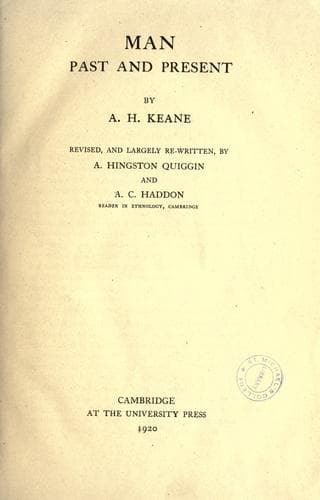
Man, Past and PresentKeane, A. H. (Augustus Henry)
History
Man, Past and Present
Keane, A. H. (Augustus Henry)
Anthropology; Ethnology
affinities are with the Oceanic populations. But in 218 B.C., Lu-kiang
having been reduced and incorporated with China proper, a large number
of Chinese emigrants settled in the country, and gradually merged with
the Giao-shi in a single nationality, whose twofold descent is still
reflected in the Annamese physical and mental characters.
This term Annam[465], however, did not come into use till the seventh
century, when it was officially applied to the frontier river between
China and Tonking, and afterwards extended to the whole of Tonking and
Cochin-China. Tonking itself, meaning the "Eastern Court[466]," was
originally the name only of the city of Ha-noi when it was a royal
residence, but was later extended to the whole of the northern kingdom,
whose true name is _Yueeh-nan_. To this corresponded the southern
Kwe-Chen-Ching, "Kingdom of Chen-Ching," which was so named in the ninth
century from its capital Chen-Ching, and of which our Cochin-China
appears to be a corrupt form.
But, amid all this troublesome political nomenclature, the dominant
Annamese nation has faithfully preserved its homogeneous character,
spreading, like the Siamese Shans, steadily southwards, and gradually
absorbing the whole of the Champa domain to the southern extremity of
the peninsula, as well as a large part of the ancient kingdom of Camboja
about the Mekhong delta. They thus form at present the almost exclusive
ethnical element throughout all the lowland and cultivated parts of
Tonking, upper and lower Cochin-China and south Camboja, with a total
population in 1898 of about twenty millions.
The Annamese are described in a semi-official report[467] as
characterised by a high broad forehead, high cheek-bones, small crushed
nose, rather thick lips, black hair, scant beard, mean height, coppery
complexion, deceitful (_rusee_) expression, and rude or insolent
bearing. The head is round (index 83 to 84) and the features are in
general flat and coarse, while to an ungainly exterior corresponds a
harsh unsympathetic temperament. The Abbe Gagelin, who lived years in
their midst, frankly declares that they are at once arrogant and
dishonest, and dead to all the finer feelings of human nature, so that
after years of absence the nearest akin will meet without any outward
sign of pleasure or affection. Others go further, and J. G. Scott summed
it all up by declaring that "the fewer Annamese there are, the less
taint there is on the human race." No doubt Lord Curzon gives a more
favourable picture, but this traveller spent only a short time in the
country, and even he allows that they are "tricky and deceitful,
disposed to thieve when they get the chance, mendacious, and incurable
gamblers[468]."
Public-domain text, read in full here on John Shaqi.
Reviews
Reviews
No reviews yet
Be the first to share your thoughts on this work.
Elsewhere in the archive
Join the Discussion
Join the discussion
Sign in to leave a comment or review.
Sign InorCreate an account