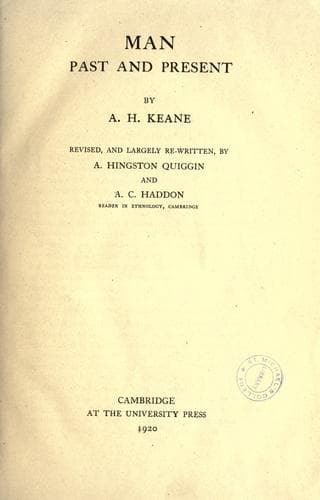
Man, Past and PresentKeane, A. H. (Augustus Henry)
History
Man, Past and Present
Keane, A. H. (Augustus Henry)
Anthropology; Ethnology
[477] The first actual date given is that of Tai Hao (Fu-hi), 2953 B.C.,
but this ruler belongs to the fabulous period, and is stated to have
reigned 115 years. The first certain date would appear to be that of
Yau, first of the Chinese sages and reformer of the calendar (2357
B.C.). The date 2254 B.C. for Confucius's model king Shun seems also
established. But of course all this is modern history compared with the
now determined Babylonian and Egyptian records.
[478] Amongst the metals reference is made to iron so early as the time
of the Emperor Ta Yue (2200 B.C.), when it is mentioned as an article of
tribute in the _Shu-King_. F. Hirth, who states this fact, adds that
during the same period, if not even earlier, iron was already a
flourishing industry in the Liang district (Paper on the "History of
Chinese Culture," Munich Anthropological Society, April, 1898). At the
discussion which followed the reading of this paper Montelius argued
that iron was unknown in Western Asia and Egypt before 1500 B.C.,
although the point was contested by Hommel, who quoted a word for iron
in the earliest Egyptian texts. Montelius, however, explained that terms
originally meaning "ore" or "metal" were afterwards used for "iron."
Such was certainly the case with the Gk. [Greek: chalkos], at first
"copper," then metal in general, and used still later for [Greek:
sideros], "iron"; hence [Greek: chalkeus] = coppersmith, blacksmith, and
even goldsmith. So also with the Lat. _aes_ (Sanskrit _ayas_, akin to
_aurora_, with simple idea of brightness), used first especially for
copper (_aes cyprium, cuprum_), and then for _bronze_ (Lewis and Short).
For Hirth's later views see his _Ancient History of China_, 1908 (from
the fabulous ages to 221 B.C.).
[479] This term _Y-jen_ (_Yi-jen_), meaning much the same as _Man_,
_Man-tse_, savage, rude, untameable, has acquired a sort of diplomatic
distinction. In the treaty of Tien-tsin (1858) it was stipulated that it
should no longer, as heretofore, be applied in official documents to the
English or to any subjects of the Queen.
[480] See J. Edkins, _China's Place in Philology_, p. 117. The Hok-los
were originally from Fo-kien, whence their alternative name, _Fo-lo_.
The _lo_ appears to be the same word as in the reduplicated _Lo-lo_,
meaning something like the Greek and Latin _Bar-bar_, stammerers, rude,
uncultured.
[481] The _Hakkas_, _i.e._ "strangers," speak a well-marked dialect
current on the uplands between Kwang-tung, Kiang-si, and Fo-kien. J.
Dyer Ball, _Easy Lessons in the Hakka Dialect_, 1884.
[482] Numerous in the western parts of Kwang-tung and in the Canton
district. J. Dyer Ball, _Cantonese Made Easy_, Hongkong, 1884.
Public-domain text, read in full here on John Shaqi.
Reviews
Reviews
No reviews yet
Be the first to share your thoughts on this work.
Elsewhere in the archive
Join the Discussion
Join the discussion
Sign in to leave a comment or review.
Sign InorCreate an account