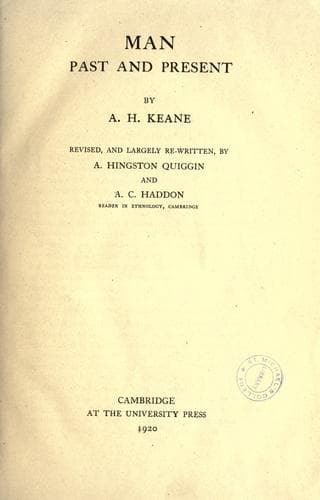
Man, Past and PresentKeane, A. H. (Augustus Henry)
History
Man, Past and Present
Keane, A. H. (Augustus Henry)
Anthropology; Ethnology
[483] In this expression "Pidgin" appears to be a corruption of the word
_business_ taken in a very wide sense, as in such terms as
_talkee-pidgin_ = a conversation, discussion; _singsong pidgin_ = a
concert, etc. It is no unusual occurrence for persons from widely
separated Chinese provinces meeting in England to be obliged to use this
common jargon in conversation.
[484] For the aboriginal peoples, with bibliography, see M. Kennelly's
translation of L. Richard's _Comprehensive Geography of the Chinese
Empire and its Dependencies_, 1908, pp. 371-3.
[485] _Kung-tse_, "Teacher Kung," or more fully _Kung-fu-tse_, "the
eminent teacher Kung," which gives the Latinised form _Confucius_.
[486] _Kwong Ki Chiu_, 1881, p. 875. Confucius was born in 550 and died
in 477 B.C., and to him are at present dedicated as many as 1560
temples, in which are observed real sacrificial rites. For these
sacrifices the State yearly supplies 26,606 sheep, pigs, rabbits and
other animals, besides 27,000 pieces of silk, most of which things,
however, become the "perquisites" of the attendants in the sanctuaries.
[487] Arthur H. Smith, _Chinese Characteristics_, New York, 1895. The
good, or at least the useful, qualities of the Chinese are stated by
this shrewd observer to be a love of industry, peace, and social order,
a matchless patience and forbearance under wrongs and evils beyond cure,
a happy temperament, no nerves, and "a digestion like that of an
ostrich." See also H. A. Giles, _China and the_ _Chinese_, 1902; E. H.
Parker, _John Chinaman and a Few Others_, 1901; J. Dyer Ball, _Things
Chinese_, 1903; and M. Kennelly in Richard's _Comprehensive Geography of
the Chinese Empire and its Dependencies_, 1908.
[488] See _Contemporary Review_, Feb. 1908, "Report on Christian
Missions in China," by Mr F. W. Fox, Professor Macalister and Sir
Alexander Simpson.
[489] A happy Portuguese coinage from the Malay _mantri_, a state
minister, which is the Sanskrit _mantrin_, a counsellor, from _mantra_,
a sacred text, a counsel, from Aryan root _man_, to think, know, whence
also the English _mind_.
[490] Miss Bird (Mrs Bishop), _The Golden Chersonese_, 1883, p. 37.
[491] H. A. Giles, _The Civilisation of China_, 1911, p. 237. See
especially Chap. XI., "Chinese and Foreigners," for the etiquette of
street regulations and the habit of shouting conversation.
CHAPTER VII
THE OCEANIC MONGOLS
Public-domain text, read in full here on John Shaqi.
Reviews
Reviews
No reviews yet
Be the first to share your thoughts on this work.
Elsewhere in the archive
Join the Discussion
Join the discussion
Sign in to leave a comment or review.
Sign InorCreate an account