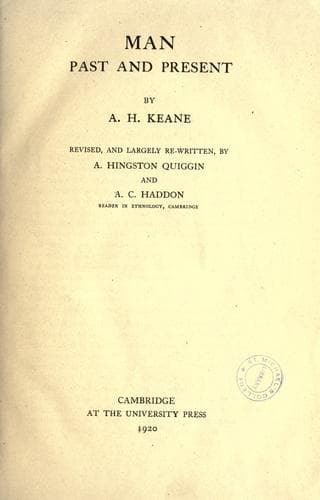
Man, Past and PresentKeane, A. H. (Augustus Henry)
History
Man, Past and Present
Keane, A. H. (Augustus Henry)
Anthropology; Ethnology
[696] It still persists, however, as a tribal designation both amongst
the Kirghiz and Uzbegs, and in 1885 Potanin visited the _Yegurs_ of the
Edzin-gol valley in south-east Mongolia, said to be the last surviving
representatives of the Uigur nation (H. Schott, "Zur Uigurenfrage," in
_Abhandl. d. k. Akad. d. Wiss._, Berlin, 1873, pp. 101-21).
[697] Ch. de Ujfalvy, _Les Aryens au Nord et au Sud de l'Hindou-Kouch_,
p. 28.
[698] "Notes on the Physical Anthropology of Chinese Turkestan and the
Pamirs," _Journ. Roy. Anthr. Inst._ XLII. 1912.
[699] "The Uzi of the Greeks are the Gozz [Ghuz] of the Orientals. They
appear on the Danube and the Volga, in Armenia, Syria, and Chorasan, and
their name seems to have been extended to the whole Turkoman [Turki]
race" [by the Arab writers]; Gibbon, Ch. LVII.
[700] Who take their name from a mythical Uz-beg, "Prince Uz" (_beg_ in
Turki = a chief, or hereditary ruler).
[701] Both of these take their name, not from mythical but from
historical chiefs:--_Kazan Khan_ of the Volga, "the rival of Cyrus and
Alexander," who was however of the house of Jenghiz, consequently not a
Turk, like most of his subjects, but a true Mongol (_ob._ 1304); and
_Noga_, the ally and champion of Michael Palaeologus against the Mongols
marching under the terrible Holagu almost to the shores of the Bosporus.
[702] Gibbon, Chap. LVII. By the "Turkish nation" is here to be
understood the western section only. The Turks of Mawar-en-Nahar and
Kashgaria (Eastern Turkestan) had been brought under the influences of
Islam by the first Arab invaders from Persia two centuries earlier.
[703] "Die Stellung der Tuerken in Europa," in _Geogr. Zeitschrift_,
Leipzig, 1897, Part 5, p. 250 sq.
[704] "Ethnographic Researches," edited by N. E. Vasilofsky for the
_Imperial Geogr. Soc._ 1896, quoted in _Nature_, Dec. 3, 1896, p. 97.
[705] A. Erman, _Reise um die Erde_, 1835, Vol. III. p. 51.
[706] Quoted by Peschel, _Races of Man_, p. 383.
[707] M. Balkashin in _Izvestia Russ. Geogr. Soc._, April, 1883.
[708] _Kara_ = "Black," with reference to the colour of their round felt
tents.
[709] On the obscure relations of these Hordes to the Kara-Kirghiz and
prehistoric Usuns some light has been thrown by the investigations of N.
A. Aristov, a summary of whose conclusions is given by A. Ivanovski in
_Centralblatt fuer Anthropologie_, etc., 1896, p. 47.
Public-domain text, read in full here on John Shaqi.
Reviews
Reviews
No reviews yet
Be the first to share your thoughts on this work.
Elsewhere in the archive
Join the Discussion
Join the discussion
Sign in to leave a comment or review.
Sign InorCreate an account