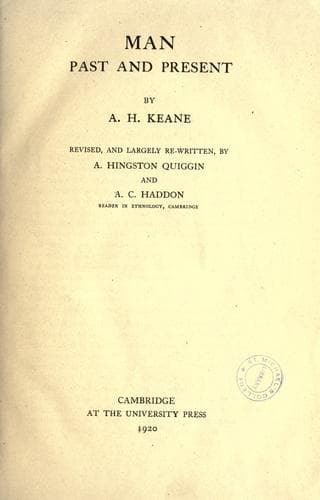
Man, Past and PresentKeane, A. H. (Augustus Henry)
History
Man, Past and Present
Keane, A. H. (Augustus Henry)
Anthropology; Ethnology
[710] Although officially returned as Muhammadans of the Sunni sect,
Levchine tells as that it is hard to say whether they are Moslem, Pagan
(Shamanists), or Manichean, this last because they believe God has made
good angels called _Mankir_ and bad angels called _Nankir_. Two of these
spirits sit invisibly on the shoulders of every person from his birth,
the good on the right, the bad on the left, each noting his actions in
their respective books, and balancing accounts at his death. It is
interesting to compare these ideas with those of the Uzbeg prince who
explained to Lansdell that at the resurrection, the earth being flat,
the dead grow out of it like grass; then God divides the good from the
bad, sending these below and those above. In heaven nobody dies, and
every wish is gratified; even the wicked creditor may seek out his
debtor, and in lieu of the money owing may take over the equivalent in
his good deeds, if there be any, and thus be saved (_Through Central
Asia_, 1887, p. 438).
[711] See especially his _Reiseberichte u. Briefe aus den Jahren
1845-49_, p. 401 sq.; and _Versuch einer Koibalischen u. Karagassischen
Sprachlehre_, 1858, Vol. I. _passim_. But cf. J. Szinnyei,
_Finnisch-ugrische Sprachwissenschaft_, 1910, pp. 19-20.
[712] Peschel, _Races of Man_, p. 386.
[713] In a suggestive paper on this collection of Finnish songs C. U.
Clark (_Forum_, April, 1898, p. 238 sq.) shows from the primitive
character of the mythology, the frequent allusions to copper or bronze,
and the almost utter absence of Christian ideas and other indications,
that these songs must be of great antiquity. "There seems to be no doubt
that some parts date back to at least 3000 years ago, before the Finns
and the Hungarians had become distinct peoples; for the names of the
divinities, many of the customs, and even particular incantations and
bits of superstitions mentioned in the Kalevala are curiously duplicated
in ancient Hungarian writings."
[714] When Ohthere made his famous voyage round North Cape to the Cwen
Sea (White Sea) all this Arctic seaboard was inhabited, not by Samoyeds,
as at present, but by true Finns, whom King Alfred calls _Beormas_,
_i.e._ the _Biarmians_ of the Norsemen, and the _Permiaki_ (_Permians_)
of the Russians (_Orosius_, I. 13). In medieval times the whole region
between the White Sea and the Urals was often called Permia; but since
the withdrawal southwards of the Zirynians and other Permian Finns this
Arctic region has been thinly occupied by Samoyed tribes spreading
slowly westward from Siberia to the Pechora and Lower Dvina.
Public-domain text, read in full here on John Shaqi.
Reviews
Reviews
No reviews yet
Be the first to share your thoughts on this work.
Elsewhere in the archive
Join the Discussion
Join the discussion
Sign in to leave a comment or review.
Sign InorCreate an account