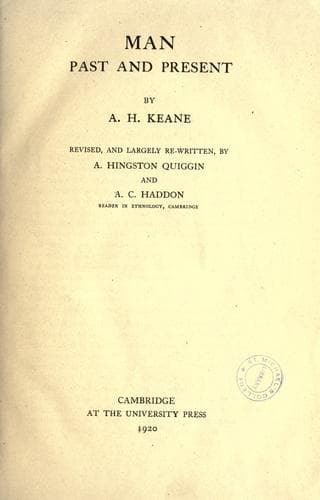
Man, Past and PresentKeane, A. H. (Augustus Henry)
History
Man, Past and Present
Keane, A. H. (Augustus Henry)
Anthropology; Ethnology
The three main varieties of hair are the _straight_, the _wavy_ and the
so-called _woolly_, termed respectively _Leiotrichous_, _Cymotrichous_
and _Ulotrichous_[128]. Straight hair usually falls straight down,
though it may curl at the ends, it is generally coarse and stiff, and is
circular in section. Wavy hair is undulating, forming long curves or
imperfect spirals, or closer rings or curls, and the section is more or
less elliptical. Woolly hair is characterised by numerous, close, often
interlocking spirals, 1-9 mm. in diameter, the section giving the form
of a lengthened ellipse. Straight hair is usually the longest, and
woolly hair the shortest, wavy hair occupying an intermediate position.
SCHEME OF CLASSIFICATION.
I. ULOTRICHI (Woolly-haired).
1. The African Negroes, Negrilloes, Bushmen.
2. The Oceanic Negroes: Papuans, Melanesians in part, Tasmanians,
Negritoes.
II. LEIOTRICHI (Straight-haired).
1. The Southern Mongols.
2. The Oceanic Mongols, Polynesians in part.
3. The Northern Mongols.
4. The American Aborigines.
III. CYMOTRICHI (Curly or Wavy-haired).
1. The Pre-Dravidians: Vedda, Sakai, etc., Australians.
2. The "Caucasic" peoples:
A. Southern Dolichocephals: Mediterraneans, Hamites, Semites,
Dravidians, Indonesians, Polynesians in part.
B. Northern Dolichocephals: Nordics, Kurds, Afghans, some
Hindus.
C. Brachycephals: Alpines, including the short Cevenoles
of Western and Central Europe, and tall Adriatics or
Dinarics of Eastern Europe and the Armenians of Western
Asia.
FOOTNOTES:
[66] Thus Lucretius:
"Posterius ferri vis est aerisque reperta,
Sed prior aeris erat quam ferri cognitus usus."
[67] J. Dechelette points out that the term Copper "Age" is not
justified for the greater part of Europe, as it suggests a demarcation
which does not exist and also a more thorough chemical analysis of early
metals than we possess. He prefers the term aeneolithic (_aeneus_,
copper, [Greek: lithos], stone), coined by the Italians, to denote the
period of transition, dating, according to Montelius, from about 2500
B.C. to 1900 B.C. _Manuel d'Archeologie prehistorique_, II. 1, _Age du
Bronze_, 1910, pp. 99-100, 105.
[68] _Eth._, Chap. XIII.
[69] See G. Elliot Smith, _The Ancient Egyptians_, 1911, pp. 97-8.
[70] Paper on "The Transition from Pure Copper to Bronze," etc., read at
the Meeting of the Brit. Assoc. Liverpool, 1896.
[71] _Loc. cit._ p. 3. But cf. H. R. Hall, _The Ancient History of the
Near East_, 1912, pp. 33 and 90 _n._ 2.
[72] G. A. Reisner, _The Early Cemeteries of Naga-ed-der_ (University of
California Publications), 1908, and _Report of the Archaeological Survey
of Nubia_, 1907-8.
[73] "Campagnes de 1907-8," _Comptes Rendus de l'Academie des
Inscriptions et Belles-Lettres_, 1908, p. 373.
Public-domain text, read in full here on John Shaqi.
Reviews
Reviews
No reviews yet
Be the first to share your thoughts on this work.
Join the Discussion
Join the discussion
Sign in to leave a comment or review.
Sign InorCreate an account