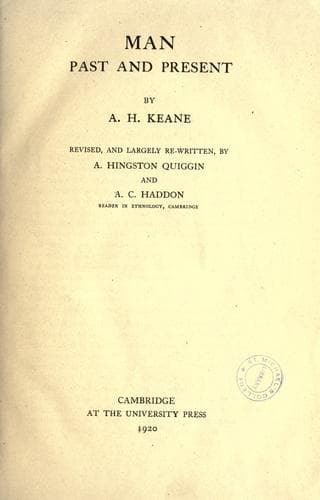
Man, Past and PresentKeane, A. H. (Augustus Henry)
History
Man, Past and Present
Keane, A. H. (Augustus Henry)
Anthropology; Ethnology
[74] Cf. J. Dechelette, _Manuel d'Archeologie prehistorique_, II. 1,
_Age du Bronze_, 1910, pp. 53-4.
[75] Cf. L. W. King, _A History of Sumer and Akkad_, 1910, p. 26.
[76] G. Coffey, _The Bronze Age in Ireland_, 1913, p. 6.
[77] _L'Anthropologie_, 1896, p. 526 sq. This antiquary aptly remarks
that "l'expression age de cuivre a une signification bien precise comme
s'appliquant a la partie de la periode de la pierre polie ou les metaux
font leur apparition."
[78] _L'Anthropologie_, 1896, p. 526 sq.
[79] In _Die Kupferzeit in Europa_, 1886.
[80] "Neuere Studien ueber die Kupferzeit," in _Zeitschr. f. Eth._ 1896,
No. 2.
[81] Otto Helm, "Chemische Untersuchungen vorgeschichtlicher Bronzen,"
in _Zeitschr. f. Eth._ 1897, No. 2. This authority agrees with Hampel's
view that further research will confirm the suggestion that in
Transylvania (Hungary) "eine Kupfer-Antimonmischung vorangegangen,
welche zugleich die Bronzekultur vorbereitete" (_ib._ p. 128).
[82] _Proc. Soc. Bib. Archaeol._ 1892, pp. 223-6.
[83] For the chronology of the Copper and Bronze Ages see p. 27.
[84] Copper and tin are found together in abundance in Southern China,
but this is archaeologically speaking an unknown land; "to search for
the birth-place of bronze in China is therefore barren of positive
results," _British Museum Guide to the Antiquities of the Bronze Age_,
1904, p. 10.
[85] T. Rice Holmes, _Ancient Britain_, 1907, pp. 483-498.
[86] _British Museum Guide to the Antiquities of the Bronze Age_, 1904,
p. 10.
[87] J. de Morgan, _Les Premieres Civilisations_, 1909, pp. 169, 337 ff.
[88] J. Dechelette, _Manuel d'Archeologie prehistorique_, II. 1, _Age du
Bronze_, 1910, pp. 98 and 397 ff.
[89] J. Dechelette, _loc. cit._ p. 63 _n._
[90] G. Coffey, _The Bronze Age in Ireland_, 1913, pp. V, 78.
[91] J. Dechelette, _Manuel d'Archeologie prehistorique_, II. 1, _Age du
Bronze_, 1910, p. 355 _n._
[92] _Guide to the Antiquities of the Early Iron Age_ (British Museum),
1905, p. 2.
[93] Wainwright, "Pre-dynastic iron beads in Egypt," _Man_, 1911, p.
177. See also H. R. Hall, "Note on the early use of iron in Egypt,"
_Man_, 1903, p. 147.
[94] W. Belck attributes the introduction of iron into Crete in 1500
B.C. to the Phoenicians, whom he derives from the neighbourhood of the
Persian Gulf. He suggests that these traders were already acquainted
with the metal in S. Arabia in the fourth millennium, and that it was
through them that a piece found its way into Egypt in the fourth
dynasty. "Die Erfinder des Eisentechnik," _Zeitschrift f. Ethnologie_,
1910. See also F. Stuhlmann, _Handwerk und Industrie in Ostafrika_,
1910, p. 49 ff., who on cultural grounds derives the knowledge of iron
in Africa from an Asiatic source.
Public-domain text, read in full here on John Shaqi.
Reviews
Reviews
No reviews yet
Be the first to share your thoughts on this work.
Join the Discussion
Join the discussion
Sign in to leave a comment or review.
Sign InorCreate an account