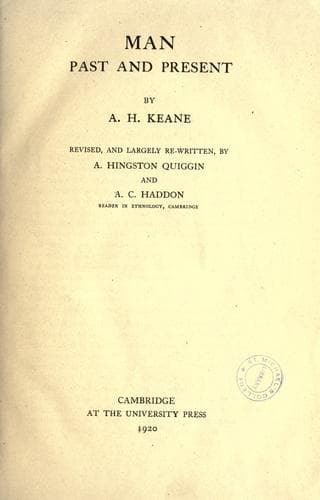
Man, Past and PresentKeane, A. H. (Augustus Henry)
History
Man, Past and Present
Keane, A. H. (Augustus Henry)
Anthropology; Ethnology
#Speech#, _almost everywhere in the agglutinating state, generally with
suffixes_.
#Religion#, _anthropomorphic_; _spirits endowed with human attributes,
mostly evil and more powerful than man_; _ancestry-worship, fetishism,
and witchcraft very prevalent_; _human sacrifices to the dead a common
feature_.
#Culture#, _low_; _cannibalism formerly rife, perhaps universal, still
general in some regions_; _no science or letters_; _arts and industries
confined mainly to agriculture, pottery, wood-carving, weaving, and
metallurgy_; _no perceptible progress anywhere except under the
influence of higher races_.
Main[129] Divisions.
#West Sudanese#: _Wolof_; _Mandingan_; _Felup_; _Timni_; _Kru_; _Sierra
Leonese_; _Liberian_; _Tshi, Ewe, and Yoruba_; _Ibo_; _Efik_; _Borgu_;
_Mossi_.
#Central Sudanese#: _Songhai_; _Hausa_; _Mosgu_; _Kanembu_; _Kanuri_;
_Baghirmi_; _Yedina_.
#East Sudanese#: _Maba_; _Fur_; _Nuba_; _Shilluk_; _Dinka_; _Bari_;
_Abaka_; _Bongo_; _Mangbattu_; _Zandeh_; _Momfu_; _Base_; _Barea_.
* * * * *
From the anthropological standpoint Africa falls into two distinct
sections, where the highest (Caucasic) and the lowest (Negro) divisions
of mankind have been conterminous throughout all known time. Mutual
encroachments and interpenetrations have probably been continuous, and
indeed are still going on. Yet so marked is the difference between the
two groups, and such is the tenacity with which each clings to its
proper domain, that, despite any very distinct geographical frontiers,
the ethnological parting line may still be detected. Obliterated at one
or two points, and at others set back always in favour of the higher
division, it may be followed from the Atlantic coast along the course of
the Senegal river east by north to the great bend of the Niger at
Timbuktu; then east by south to Lake Chad, beyond which it runs nearly
due east to Khartum, at the confluence of the White and Blue Niles.
From this point the now isolated Negro groups (Base and Barea), on the
northern slope of the Abyssinian plateau, show that the original
boundary was at first continued still east to the Red Sea at or about
Massowa. But for many ages the line appears to have been deflected from
Khartum along the White Nile south to the Sobat confluence, then
continuously south-eastwards round by the Sobat Valley to the Albert
Nyanza, up the Somerset Nile to the Victoria Nyanza, and thence with a
considerable southern bend round Masailand eastwards to the Indian Ocean
at the equator.
Public-domain text, read in full here on John Shaqi.
Reviews
Reviews
No reviews yet
Be the first to share your thoughts on this work.
Join the Discussion
Join the discussion
Sign in to leave a comment or review.
Sign InorCreate an account