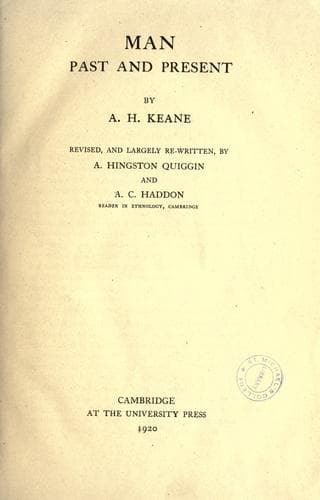
Man, Past and PresentKeane, A. H. (Augustus Henry)
History
Man, Past and Present
Keane, A. H. (Augustus Henry)
Anthropology; Ethnology
Although the Bantu language may, as some suppose[139], have originated
in the north and spread southwards to the Congo, Zambesi, and Limpopo
basins, it cannot now be even remotely affiliated to any one of the
numerous distinct forms of speech current in the Sudanese domain. Hence
to allow time for its diffusion over half the continent, the initial
movement must be assigned to an extremely remote epoch, and a
corresponding period of great duration must be postulated for the
profound linguistic disintegration that is everywhere witnessed in the
region between the Atlantic and Abyssinia. Here agglutination, both with
prefixed and postfixed particles, is the prevailing morphological order,
as in the Mandingan, Fulah, Nubian, Dinkan, and Mangbattu groups. But
every shade of transition is also presented between true agglutination
and inflection of the Hamito-Semitic types, as in Hausa, Kanuri, Kanem,
Dasa or Southern and Teda or Northern Tibu[140].
Elsewhere, and especially in Upper Guinea, the originally agglutinating
tongues have developed on lines analogous to those followed by Tibetan,
Burmese, Chinese, and Otomi in other continents, with corresponding
results. Thus the Tshi, Ewe, and Yoruba, surviving members of a now
extinct stock-language, formerly diffused over the whole region between
Cape Palmas and the Niger Delta, have become so burdened with
monosyllabic homophones (like-sounding monosyllables), that to indicate
their different meanings several distinguishing tones have been evolved,
exactly as in the Indo-Chinese group. In Ewe (Slave Coast) the root
_do_, according as it is toned may mean to put, let go, tell, kick, be
sad, join, change, grow big, sleep, prick, or grind. So great are the
ravages of phonetic decay, that new expedients have been developed to
express quite simple ideas, as in Tshi (Gold Coast) _addanmu_, room
(_addan_ house, _mu_ interior); _akwancherifo_, a guide (_akwan_ road,
_cheri_ to show, _fo_ person); _ensahtsiabah_, finger (_ensah_ hand,
_tsia_ small, _abbah_ child = hand's-little-child); but middle-finger =
"hand's-little-chief" (_ensahtsiahin_, where _ehin_ chief takes the
place of _abbah_ child[141]).
Public-domain text, read in full here on John Shaqi.
Reviews
Reviews
No reviews yet
Be the first to share your thoughts on this work.
Join the Discussion
Join the discussion
Sign in to leave a comment or review.
Sign InorCreate an account