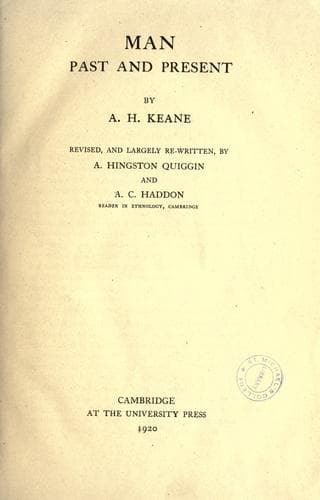
Man, Past and PresentKeane, A. H. (Augustus Henry)
History
Man, Past and Present
Keane, A. H. (Augustus Henry)
Anthropology; Ethnology
It has also to be considered that all the old tribal relations were
broken up, while an attempt was made to merge these waifs and strays in
a single community based on social conditions to which each and all were
utter strangers. It is not therefore surprising that the experiment has
not proved a complete success, and that the social relations in Sierra
Leone leave something to be desired. Although the freedmen and the
rescued captives received free gifts of land, their dislike for the
labours of the field induced many to abandon their holdings, and take to
huckstering and other more pleasant pursuits. Hence their descendants
almost monopolise the petty traffic and even the "professions" in
Freetown and the other colonial settlements. Although accused of
laziness and dishonesty, they have displayed a considerable degree of
industrial as well as commercial enterprise, and the Sierra Leone
craftsmen--smiths, mechanics, carpenters, builders--enjoy a good
reputation in all the coast towns. All are Christians of various
denominations, and even show a marked predilection for the "ministry."
Yet below the surface the old paganism still slumbers, and vodoo
practices, as in the West Indies and some of the Southern States, are
still heard of.
Morality also is admittedly at a low ebb, and it is curious to note that
this has in part been attributed to the freedom enjoyed under the
British administration. "They have passed from the sphere of native law
to that of British law, which is brought to this young community like an
article of ready-made clothing. Is it a wonder that the clothes do not
fit? Is it a wonder that kings and chiefs around Sierra Leone, instead
of wishing their people to come and see how well we do things, dread for
them to come to this colony on account of the danger to their morals? In
passing into this colony, they pass into a liberty which to them is
license[153]."
An experiment of a somewhat different order, but with much the same
negative results, has been tried by the well-meaning founders of the
Republic of Liberia. Here also the bulk of the "civilised aristocrats"
are descended of emancipated plantation slaves, a first consignment of
whom was brought over by a philanthropic American society in 1820-22.
The idea was to start them well in life under the fostering care of
their white guardians, and then leave them to work out their own
redemption in their own way. All control was accordingly withdrawn in
1848, and since then the settlement has constituted an absolutely
independent Negro state in the enjoyment of complete self-government.
Progress of a certain material kind was undoubtedly made. The original
"free citizens" increased from 8000 in 1850 to perhaps 20,000 in
1898[154], and the central administration, modelled on that of the
United States, maintained some degree of order among the surrounding
aborigines, estimated at some two million within the limits of the
Republic.
Public-domain text, read in full here on John Shaqi.
Reviews
Reviews
No reviews yet
Be the first to share your thoughts on this work.
Join the Discussion
Join the discussion
Sign in to leave a comment or review.
Sign InorCreate an account