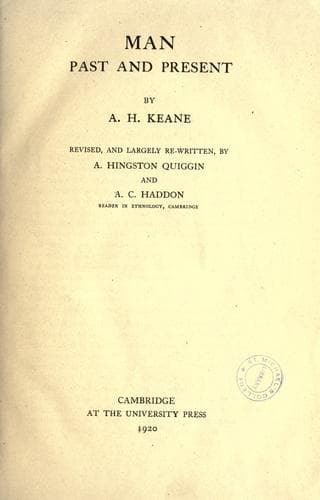
Man, Past and PresentKeane, A. H. (Augustus Henry)
History
Man, Past and Present
Keane, A. H. (Augustus Henry)
Anthropology; Ethnology
But these aborigines have not benefited perceptibly by contact with
their "civilised" neighbours, who themselves stand at much the same
level intellectually and morally as their repatriated forefathers.
Instead of attending to the proper administration of the Republic, the
"Weegee," as they are called, have constituted themselves into two
factions, the "coloured" or half-breeds, and the full-blood Negroes who,
like the "Blancos" and "Neros" of some South American States, spend most
of their time in a perpetual struggle for office. All are of course
intensely patriotic, but their patriotism takes a wrong direction, being
chiefly manifested in their insolence towards the English and other
European traders on the coast, and in their supreme contempt for the
"stinking bush-niggers," as they call the surrounding aborigines. In
1909 internal and external difficulties led to the appointment of a
Commission by President Roosevelt with the result that the American
Government took charge of the finances, military organisation,
agriculture and boundary questions, besides arranging for a loan of
L400,000. The able administration of President Barclay, a pure blooded
Negro, though not of Liberian ancestry, is perhaps the happiest augury
for the future of the Republic[155].
The _Krus_ (Kroomen, Krooboys[156]), whose numerous hamlets are
scattered along the coast from below Monrovia nearly to Cape Palmas, are
assuredly one of the most interesting people in the whole of Africa.
Originally from the interior, they have developed in their new homes a
most un-African love of the sea, hence are regularly engaged as crews by
the European skippers plying along those insalubrious coastlands.
In this service, in which they are known by such nicknames as
"Bottle-of-Beer," "Mashed-Potatoes," "Bubble-and-Squeak,"
"Pipe-of-Tobacco," and the like, their word may always be depended upon.
But it is to be feared that this loyalty, which with them is a strict
matter of business, has earned for them a reputation for other virtues
to which they have little claim. Despite the many years that they have
been in the closest contact with the missionaries and traders, they are
still at heart the same brutal savages as ever. After each voyage they
return to the native village to spend all their gains and pilferings in
drunken orgies, and relapse generally into sheer barbarism till the next
steamer rounds the neighbouring headland. "It is not a comfortable
reflection," writes Bishop Ingham, whose testimony will not be suspected
of bias, "as we look at this mob on our decks, that, if the ship chance
to strike on a sunken rock and become unmanageable, they would rise to a
man, and seize all they could lay hands on, cut the very rings off our
fingers if they could get them in no other way, and generally loot the
ship. Little has been done to Christianise these interesting,
hard-working, cheerful, but ignorant and greedy people, who have so long
hung on the skirts of civilisation[157]."
Public-domain text, read in full here on John Shaqi.
Reviews
Reviews
No reviews yet
Be the first to share your thoughts on this work.
Join the Discussion
Join the discussion
Sign in to leave a comment or review.
Sign InorCreate an account