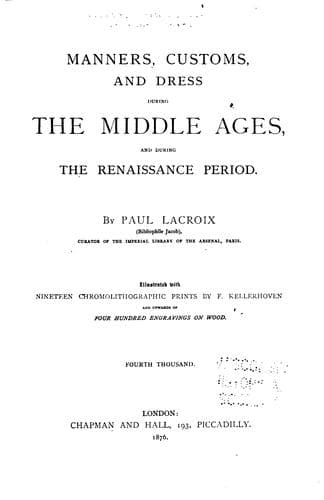
Manners, Customs, and Dress During the Middle Ages and During the Renaissance PeriodJacob, P. L.
History
Manners, Customs, and Dress During the Middle Ages and During the Renaissance Period
Jacob, P. L.
Clothing and dress; Manners and customs; Middle Ages; Renaissance
There were two kinds of mortmain: real and personal; one concerning land,
and the other concerning the person; that is to say, land held in mortmain
did not change quality, whatever might be the position of the person who
occupied it, and a "man of mortmain" did not cease to suffer the
inconveniences of his position on whatever land he went to establish
himself.
The mortmains were generally subject to the greater share of feudal
obligations formerly imposed on serfs; these were particularly to work for
a certain time for their lord without receiving any wages, or else to pay
him the _tax_ when it was due, on certain definite occasions, as for
example, when he married, when he gave a dower to his daughter, when he
was taken prisoner of war, when he went to the Holy Land, &c., &c. What
particularly characterized the condition of mortmains was, that the lords
had the right to take all their goods when they died without issue, or
when the children held a separate household; and that they could not
dispose of anything they possessed, either by will or gift, beyond a
certain sum.
The noble who franchised mortmains, imposed on them in almost all cases
very heavy conditions, consisting of fees, labours, and fines of all
sorts. In fact, a mortmain person, to be free, not only required to be
franchised by his own lord, but also by all the nobles on whom he was
dependent, as well as by the sovereign. If a noble franchised without the
consent of his superiors, he incurred a fine, as it was considered a
dismemberment or depreciation of the fief.
As early as the end of the fourteenth century, the rigorous laws of
mortmain began to fall into disuse in the provinces; though if the name
began to disappear, the condition itself continued to exist. The free men,
whether they belonged to the middle class or to the peasantry, were
nevertheless still subject to pay fines or obligations to their lords of
such a nature that they must be considered to have been practically in the
same position as mortmains. In fact, this custom had been so deeply rooted
into social habits by feudalism, that to make it disappear totally at the
end of the eighteenth century, it required three decrees of the National
Convention (July 17 and October 2, 1793; and 8 Ventôse, year II.--that is,
March 2, 1794).
It is only just to state, that twelve or fourteen years earlier, Louis
XVI. had done all in his power towards the same purpose, by suppressing
mortmain, both real or personal, on the lands of the Crown, and personal
mortmain (i.e. the right of following mortmains out of their original
districts) all over the kingdom.
[Illustration: Fig. 23.--Alms Bag taken from some Tapestry in Orleans,
Fifteenth Century.]
Privileges and Rights. Feudal and Municipal.
Public-domain text, read in full here on John Shaqi.
Reviews
Reviews
No reviews yet
Be the first to share your thoughts on this work.
Join the Discussion
Join the discussion
Sign in to leave a comment or review.
Sign InorCreate an account