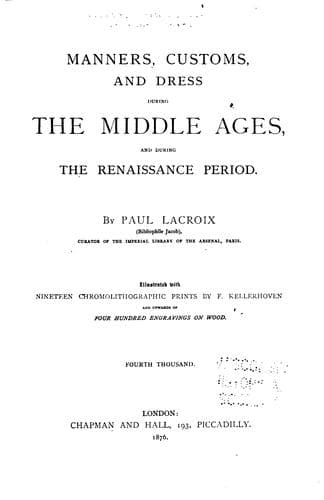
Manners, Customs, and Dress During the Middle Ages and During the Renaissance Period — John Shaqi
Manners, Customs, and Dress During the Middle Ages and During the Renaissance PeriodJacob, P. L.
History
Manners, Customs, and Dress During the Middle Ages and During the Renaissance Period
Jacob, P. L.
Clothing and dress; Manners and customs; Middle Ages; Renaissance
Elements of Feudalism.--Rights of Treasure-trove, Sporting, Safe
Conducts, Ransom, Disinheritance, &c.--Immunity of the Feudalists.--Dues
from the Nobles to their Sovereign.--Law and University Dues.--Curious
Exactions resulting from the Universal System of Dues.--Struggles to
Enfranchise the Classes subjected to Dues.--Feudal Spirit and Citizen
Spirit.--Resuscitation of the System of Ancient Municipalities in Italy,
Germany, and France.--Municipal Institutions and Associations.--The
Community.--The Middle-Class Cities (_Cités Bourgeoises_).--Origin of
National Unity.
So as to understand the numerous charges, dues, and servitudes, often as
quaint as iniquitous and vexations, which weighed on the lower orders
during the Middle Ages, we must remember how the upper class, who assumed
to itself the privilege of oppression on lands and persons under the
feudal System, was constituted.
The Roman nobles, heirs to their fathers' agricultural dominions,
succeeded for the most part in preserving through the successive invasions
of the barbarians, the influence attached to the prestige of birth and
wealth; they still possessed the greater part of the land and owned as
vassals the rural populations. The Grerman nobles, on the contrary, had
not such extended landed properties, but they appropriated all the
strongest positions. The dukes, counts, and marquises were generally of
German origin. The Roman race, mixed with the blood of the various nations
it had subdued, was the first to infuse itself into ancient Society, and
only furnished barons of a secondary order.
These heterogeneous elements, brought together, with the object of common
dominion, constituted a body who found life and motion only in the
traditions of Rome and ancient Germany. From these two historical sources,
as is very judiciously pointed out by M. Mary-Lafon, issued all the habits
of the new society, and particularly the rights and privileges assumed by
the nobility.
These rights and privileges, which we are about to pass summarily in
review, were numerous, and often curious: amongst them may be mentioned
the rights of treasure-trove, the rights of wreck, the rights of
establishing fairs or markets, rights of marque, of sporting, &c.
Public-domain text, read in full here on John Shaqi.
Reviews
Reviews
No reviews yet
Be the first to share your thoughts on this work.
Join the Discussion
Join the discussion
Sign in to leave a comment or review.
Sign InorCreate an account