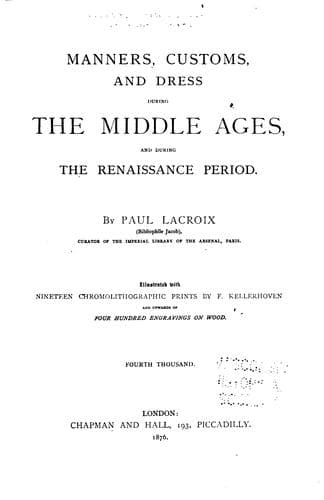
Manners, Customs, and Dress During the Middle Ages and During the Renaissance Period — John Shaqi
Manners, Customs, and Dress During the Middle Ages and During the Renaissance PeriodJacob, P. L.
History
Manners, Customs, and Dress During the Middle Ages and During the Renaissance Period
Jacob, P. L.
Clothing and dress; Manners and customs; Middle Ages; Renaissance
In a high order of ideas, what great facts serve as a foundation to our
history and that of the modern world! We have first royalty, which, weak
and debased under the Merovingians, rises and establishes itself
energetically under Pépin and Charlemagne, to degenerate under Louis le
Débonnaire and Charles le Chauve. After having dared a second time to
found the Empire of the Caesars, it quickly sees its sovereignty replaced
by feudal rights, and all its rights usurped by the nobles, and has to
struggle for many centuries to recover its rights one by one.
Feudalism, evidently of Germanic origin, will also attract our attention,
and we shall draw a rapid outline of this legislation, which, barbarian at
the onset, becomes by degrees subject to the rules of moral progress. We
shall ascertain that military service is the essence itself of the "fief,"
and that thence springs feudal right. On our way we shall protest against
civil wars, and shall welcome emancipation and the formation of the
communes. Following the thousand details of the life of the people, we
shall see the slave become serf, and the serf become peasant. We shall
assist at the dispensation of justice by royalty and nobility, at the
solemn sittings of parliaments, and we shall see the complicated details
of a strict ceremonial, which formed an integral part of the law, develop
themselves before us. The counters of dealers, fairs and markets,
manufactures, commerce, and industry, also merit our attention; we must
search deeply into corporations of workmen and tradesmen, examining their
statutes, and initiating ourselves into their business. Fashion and dress
are also a manifestation of public and private customs; for that reason we
must give them particular attention.
And to accomplish the work we have undertaken, we are lucky to have the
conscientious studies of our old associates in the great work of the
Middle Ages and the Renaissance to assist us: such as those of Emile
Bégin, Elzéar Blaze, Depping, Benjamin Guérard, Le Roux de Lincy, H.
Martin, Mary-Lafon, Francisque Michel, A. Monteil, Rabutau, Ferdinand
Séré, Horace de Viel-Castel, A. de la Villegille, Vallet de Viriville.
As in the volume of the Arts of the Middle Ages, engraving and
chromo-lithography will come to our assistance by reproducing, by means of
strict fac-similes, the rarest engravings of the fifteenth and sixteenth
centuries, and the most precious miniatures of the manuscripts preserved
in the principal libraries of France and Europe. Here again we have the
aid of the eminent artist, M. Kellerhoven, who quite recently found means
of reproducing with so much fidelity the gems of Italian painting.
Paul Lacroix
(Bibliophile Jacob).
Table of Contents.
Condition of Persons and Lands
Public-domain text, read in full here on John Shaqi.
Reviews
Reviews
No reviews yet
Be the first to share your thoughts on this work.
Join the Discussion
Join the discussion
Sign in to leave a comment or review.
Sign InorCreate an account