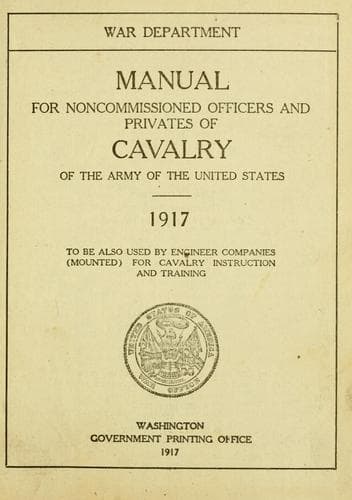
Manual for Noncommissioned Officers and Privates of Cavalry of the Army: of the United States 1917. To be also used by Engineer Companies (Mounted) for Cavalry Instruction and TrainingUnited States. War Department
History
Manual for Noncommissioned Officers and Privates of Cavalry of the Army: of the United States 1917. To be also used by Engineer Companies (Mounted) for Cavalry Instruction and Training
United States. War Department
United States. Army -- Handbooks, manuals, etc.
Place the hood in the square iron which has been folded downward
toward the bottom of the tent, and continue to fold around the square
iron as a core, pressing all folds down flat and smooth and parallel
with the bottom of the tent. If each fold is compactly made and the
canvas kept smooth, the last fold will exactly cover the lower edge of
the canvas. Lay all exposed guys along the folded canvas except the
two on the center width, which should be pulled out and away from
bottom edge to their extreme length for tying. Now, beginning at one
end, fold toward the center on the first seam (that joining the first
and second widths) and fold again toward the center, so that the
already folded canvas will come to within about 3 inches of the middle
width. Then fold over to the opposite edge of middle width of canvas.
Then begin folding from opposite end, folding the first width in half,
then making a second fold to come within about 4 or 5 inches of that
already folded; turn this fold entirely over that already folded. Take
the exposed guys and draw them taut across each other, turn bundle
over on the under guy, cross guys on top of bundle, drawing tight.
Turn bundle over on the crossed guys and tie lengthwise.
When properly tied and pressed together this will make a package 11 by
23 by 34 inches, requiring about 8,855 cubic inches to store or pack.
Stencil the organization designation on the lower half of the middle
width of canvas in the back wall.
CHAPTER VI.
FIELD SERVICE.
=Section 1. Principles of training.=
Inaction gives every advantage to the enemy.
The offensive alone gives decisive results.
A quick and energetic offensive minimizes losses.
An advance against the enemy's position once entered upon must be
continued. To go back under fire is to die.
The best way to hold down the fire of the enemy and to diminish his
power to inflict losses is to bring the position he occupies under
well-conducted and continued fire.
Present as small a target as possible to the enemy by utilizing every
bit of cover the ground affords.
Individual skill in marksmanship is an advantage in battle only when
united with fire discipline and control.
Constant movement to the front lessens the effect of the enemy's fire.
Modern battles fought in the open show that the heaviest losses are in
the mid and long ranges. When close range is reached the losses
diminish rapidly.
The best protection against artillery fire is a constant but irregular
movement to the front. When close to the enemy's position his fire is
least effective.
A knowledge of how to use the bayonet and the will to use it must
often be the deciding factors in battle.
Finally:
Public-domain text, read in full here on John Shaqi.
Reviews
Reviews
No reviews yet
Be the first to share your thoughts on this work.
Elsewhere in the archive
Join the Discussion
Join the discussion
Sign in to leave a comment or review.
Sign InorCreate an account