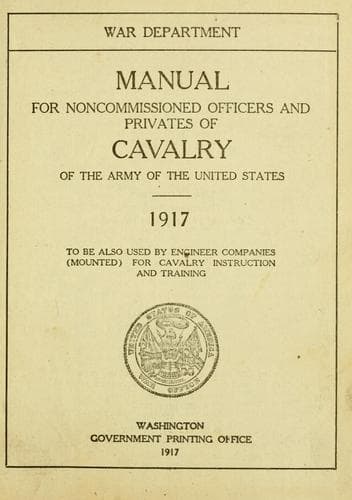
Manual for Noncommissioned Officers and Privates of Cavalry of the Army: of the United States 1917. To be also used by Engineer Companies (Mounted) for Cavalry Instruction and TrainingUnited States. War Department
History
Manual for Noncommissioned Officers and Privates of Cavalry of the Army: of the United States 1917. To be also used by Engineer Companies (Mounted) for Cavalry Instruction and Training
United States. War Department
United States. Army -- Handbooks, manuals, etc.
In training we can not go far wrong or fail to accomplish the best
results if we keep before our minds the spirit as well as the wording
of paragraph 352 of the Infantry Drill Regulations: "The duties of
infantry are many and difficult. All infantry must be fit to cope with
all conditions that may arise. Modern war requires but one kind of
infantry--good infantry." Cavalry, dismounted, should be as efficient
as infantry under all conditions of service.
=Section 2. Combat.=
The field of battle is the final test of the instruction, discipline,
and efficiency of the fighting force of any army.
The squadron is the =attack unit= or the =defense unit=, whether
operating alone or as part of a regiment. The troops constitute the
=firing line= and the =support=.
An individual soldier is concerned only with the enemy in his
immediate front, in obeying orders, and instinctively doing what he
has been trained to do.
=The one requisite necessary to win the battle is intelligent team
work.= The army is handled just like a football team. A part is on the
first line facing the enemy. Another part, like the half backs, is
held back as supports. Another part, like the full backs, is held as a
reserve. Each unit, like each player, has a certain duty to perform.
When the signal is given, all work together--all play the game--team
work. The players consist of all branches of the service.
The same rule holds true down to the smallest unit and even to the
individual enlisted man. Each regiment, is a team composed of three
players--each a squadron. Each squadron is a team of four
players--each a troop. In the same manner each troop is a team of two
or more platoons; each platoon a team of two sections; and last, but
not least, each section is a team of from 6 to 14 players.
The one question that always presents itself on the battle field every
minute of the time to every person, whether he be a general or a
private, is, "=What play has my team captain ordered, and how best may
I act so as to work in conjunction with the other players to bring
about the desired result?"--team play.=
To the trooper this means--
First. =Prompt and loyal obedience to the section leader.= Every
section always has a team captain. If the section leader and corporal
are killed or disabled, other players previously designated take their
places. If no one was designated, then the private with the longest
service takes command. When the section leader gives the command for a
certain play, don't stop to think if the play is a good one, but do
your very best to carry out the play as ordered. A poor play in which
every player enters with his whole heart (team work) will often win,
while, on the other hand, the best play in which some of the players
are skulkers and shirkers will probably fail.
Public-domain text, read in full here on John Shaqi.
Reviews
Reviews
No reviews yet
Be the first to share your thoughts on this work.
Elsewhere in the archive
Join the Discussion
Join the discussion
Sign in to leave a comment or review.
Sign InorCreate an account