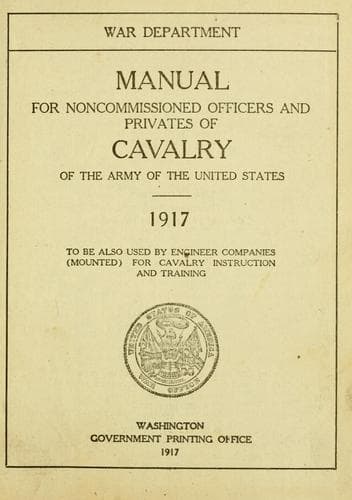
Manual for Noncommissioned Officers and Privates of Cavalry of the Army: of the United States 1917. To be also used by Engineer Companies (Mounted) for Cavalry Instruction and TrainingUnited States. War Department
History
Manual for Noncommissioned Officers and Privates of Cavalry of the Army: of the United States 1917. To be also used by Engineer Companies (Mounted) for Cavalry Instruction and Training
United States. War Department
United States. Army -- Handbooks, manuals, etc.
The movement in a succession of thin lines is used to cross a wide
stretch swept or likely to be swept by artillery fire or heavy
long-range rifle fire which can not profitably be returned. Its
purpose is the building up of a strong skirmish line preparatory to
engaging in a fire fight. This method of advancing by thin lines
results in serious, though temporary, loss of control over the
successive platoons of the troop. Its advantages lie in the fact that
it offers a less definite target, hence is less likely to draw fire.
=653.= These are merely suggested methods of advancing preliminary to
opening the fire attack; other formations better adapted to particular
occasions or terrain may be devised. The best formation is that which
advances the line the farthest without drawing the enemy's fire, or,
if he does open fire, then with the least loss of men, time, and
control.
THE FIRE ATTACK.
=654.= The principles involved in the fire attack are discussed under
=Dismounted Fire Action, the Squadron= (par. 716), and necessary
modifications as to details made under =Dismounted Action, the
Regiment= (par. 760).
When the enemy's fire makes it impracticable for the troop to move
forward in one of the above-mentioned formations, it may advance by
rushes.
Being in skirmish line: 1. =By platoon (section) from the right
(left)=, 2. =RUSH.=
The platoon leader on the indicated flank arranges the details for a
prompt and vigorous execution of the rush and puts it into effect as
soon as practicable. If necessary he designates the leader for the
indicated unit. When about to rush he causes the men of the indicated
unit to suspend firing and to hold themselves flat on the ground but
in readiness to spring forward instantly. The leader of the rush (at
the signal of the platoon leader if the latter is not the leader of
the rush) commands, =Follow me=, and, running at top speed, leads the
fraction to the new line, where he halts it and causes it to open
fire. The leader of the rush selects the new line if it has not been
previously designated.
The first fraction having established itself on the new line, the next
like fraction is sent forward by its platoon leader without further
command from the captain, and so on, successively, until the entire
troop is on the line established by the first rush.
The men must be trained to lie perfectly still until the command
(since any movement might warn the enemy of the rush to follow), then
at command to spring instantly and together to their feet, run at top
speed, and drop together at command.
=655.= In an advance by rushes, leaders of platoons in firing
positions are responsible for the delivery of an effective fire to
cover the advance of each rushing fraction. Troops are cautioned so to
fire as not to endanger the flanks of advanced portions of the firing
line. The husbanding of ammunition for the final stages of the fire
attack must be constantly impressed on the men.
Public-domain text, read in full here on John Shaqi.
Reviews
Reviews
No reviews yet
Be the first to share your thoughts on this work.
Elsewhere in the archive
Join the Discussion
Join the discussion
Sign in to leave a comment or review.
Sign InorCreate an account