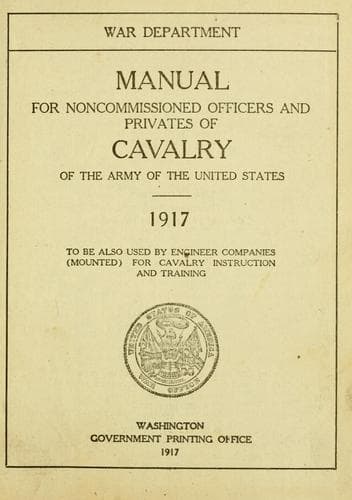
Manual for Noncommissioned Officers and Privates of Cavalry of the Army: of the United States 1917. To be also used by Engineer Companies (Mounted) for Cavalry Instruction and TrainingUnited States. War Department
History
Manual for Noncommissioned Officers and Privates of Cavalry of the Army: of the United States 1917. To be also used by Engineer Companies (Mounted) for Cavalry Instruction and Training
United States. War Department
United States. Army -- Handbooks, manuals, etc.
The rush of a troop as a whole is conducted by the captain on the same
principle as described for the platoon. The captain leads the rush,
platoon leaders lead their respective platoons, and file closers
follow the line to insure prompt and orderly execution of the advance.
When the foregoing method of rushing, by running, becomes
impracticable, any method of advance that carries the attack closer to
the enemy, such as =crawling=, should be employed.
The charge corresponds to that described =in the squadron=.
When a leader in command of a platoon or section receives an order or
signal to rush, he should cause his men to suspend firing and to hold
themselves flat but ready for a sprinter's start. He selects the
point, as far as possible with reference to cover, to which he intends
to carry his unit forward. He then gives the command "=RUSH=," springs
forward, and running at full speed about three paces ahead of his men,
leads them in the rush. Arriving at the position he has selected, he
throws himself prone, and the men drop on either side of him. All
crawl forward to good firing positions, considering the cover also,
and the leader gives the necessary orders for resuming the fire. The
latter will include giving the range again, the length of the rush
being subtracted from the sight setting ordered at the last position.
The original platoon and section divisions of the troop in the firing
line should be maintained, if possible, and should only be broken up
if the mingling of reinforcements renders it unavoidable.
Upon joining the firing line, officers and noncommissioned officers
accompanying a reinforcement take over the duties of others of like
grade who have been disabled, or they distribute themselves so as best
to exercise their normal functions. Conditions vary and no exact rules
can be prescribed. It is essential that all assist in mastering the
increased difficulties of control.
FIRE.
=657.= Ordinarily rifles are loaded and extra ammunition in bandoliers
is distributed before the troop deploys for combat. In close order the
troop executes the firings at the command of the captain, who posts
himself in rear of the center.
Firings in close order are exceptional.
=658.= =Signals during fire action=: The voice is generally inadequate
for giving commands during firing, and must be replaced by signals of
such character that proper fire direction and control are assured
(par. 989). To attract attention signals must usually be preceded by
the whistle signal (short blast). A fraction of the firing line about
to rush should avoid using the long blast signal as an indication to
=suspend firing=. Officers and men behind the firing line can not
ordinarily move freely along the line, but each must depend on the
other's watchfulness, in addition to his own, and make use of
prescribed signals (par. 997, Cav. Drill Reg., 1916). All should place
themselves so as to see their immediate superiors and subordinates.
Public-domain text, read in full here on John Shaqi.
Reviews
Reviews
No reviews yet
Be the first to share your thoughts on this work.
Elsewhere in the archive
Join the Discussion
Join the discussion
Sign in to leave a comment or review.
Sign InorCreate an account