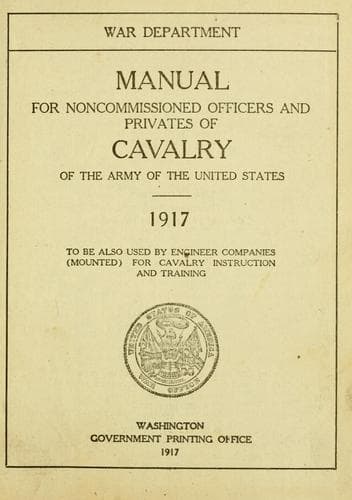
Manual for Noncommissioned Officers and Privates of Cavalry of the Army: of the United States 1917. To be also used by Engineer Companies (Mounted) for Cavalry Instruction and TrainingUnited States. War Department
History
Manual for Noncommissioned Officers and Privates of Cavalry of the Army: of the United States 1917. To be also used by Engineer Companies (Mounted) for Cavalry Instruction and Training
United States. War Department
United States. Army -- Handbooks, manuals, etc.
The bugler with the captain assists by observing the enemy, the
target, and the fire effect, and by watching for and transmitting
commands.
The effect of fire and the influence of the ground in relation
thereto, and the individual and collective instruction in marksmanship
are treated in the =Small-Arms Firing Manual=.
=659.= =Volley fire= has limited application. It has a moral effect
both on the troops employing it and on those subjected to it. It may
be employed to restore control. In defense it may be used in the early
stages of the action if the enemy presents a large compact target. It
may be used by troops especially posted on the flank or in a dominant
position in rear of an attacking force for the purpose of aiding the
advance by so-called _fire of position_. When the ground near the
target is such that the strike of bullets can be seen from the firing
line, ranging volleys may be used to correct the sight setting.
In combat, volley firing, if used, is executed habitually by platoon.
=660.= =Fire at will= is the class of fire normally employed in attack
or defense.
=661.= =Clip fire= has limited application. It is principally used
(_a_) in the early stages of combat to steady the men by habituating
them to brief pauses in firing; (_b_) to produce a short burst of
fire.
FIRE DIRECTION.
=662.= When the troop is large enough to be divided into platoons, it
is impracticable for the captain to command it in combat. His
efficiency in managing the firing line is measured by his ability to
enforce his will through the platoon leaders. Having indicated clearly
what he desires them to do, he avoids interfering except to correct
serious errors or omissions.
The captain directs the fire of his troop or of designated platoons.
He designates the target and, when practicable, allots a part of the
target to each platoon. Before beginning the fire action he determines
the range, announces the sight setting, and indicates the class of
fire to be employed and the time to open fire. Thereafter he observes
the fire effect, corrects material errors in sight setting, prevents
exhaustion of the ammunition supply, and causes the distribution of
such extra ammunition as may be received.
FIRE CONTROL.
=663.= In combat the platoon is the _fire unit_. From 20 to 35 rifles
are as many as one leader can control effectively.
Public-domain text, read in full here on John Shaqi.
Reviews
Reviews
No reviews yet
Be the first to share your thoughts on this work.
Elsewhere in the archive
Join the Discussion
Join the discussion
Sign in to leave a comment or review.
Sign InorCreate an account