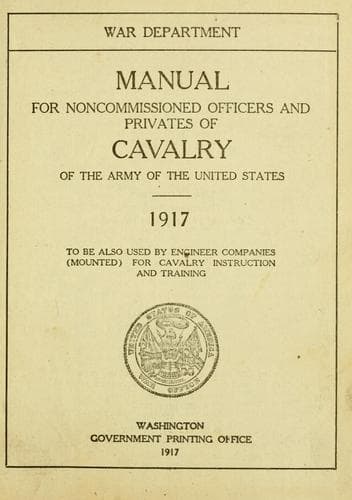
Manual for Noncommissioned Officers and Privates of Cavalry of the Army: of the United States 1917. To be also used by Engineer Companies (Mounted) for Cavalry Instruction and TrainingUnited States. War Department
History
Manual for Noncommissioned Officers and Privates of Cavalry of the Army: of the United States 1917. To be also used by Engineer Companies (Mounted) for Cavalry Instruction and Training
United States. War Department
United States. Army -- Handbooks, manuals, etc.
Each platoon leader puts into execution the commands or directions of
the captain, having first taken such precautions to insure correct
sight setting and clear description of the target or aiming point as
the situation permits or requires (par. 141); thereafter he gives such
additional commands or directions as are necessary to exact compliance
with the captain's will. He corrects the sight setting when necessary.
When the target can not be seen with the naked eye, he designates an
aiming point (by one of the methods described in par. 141 if
necessary) and orders fire upon it, first announcing the proper sight
setting to correct the error of aim.
In general, =platoon leaders= observe the target and the effect of the
fire and are on the alert for the captain's commands; they observe and
regulate the rate of fire. The =file closers= watch the firing line
and check every breach of fire discipline. =Chiefs of section=
transmit commands when necessary, observe the conduct of their
sections and abate excitement, assist in enforcing fire discipline,
and participate in the firing unless otherwise directed by the
=platoon commanders=.
The best troops are those that submit longest to fire control. To
avoid or delay such loss of control should be the constant aim of all.
Fire control implies the ability of the commander to stop the firing,
change the sight setting and target, and resume a well-directed fire.
FIRE DISCIPLINE.
=664.= Fire discipline implies, besides an unquestioning habit of
obedience to commands, a control of the rifle by the soldier (the
result of training), which will enable him in action to make hits
instead of misses. It embraces taking advantage of the ground; proper
understanding of orders as to target designation; care in setting the
sight and delivery of fire; constant attention to the orders of the
leaders, and careful observation of the enemy; an increase of fire
when the target is favorable, and a cessation of fire when the enemy
disappears; economy of ammunition. Orderly and regular methods on the
part of leaders aid fire discipline. Self possession and a confident
tone in giving commands and instructions are indispensable.
In combat, shots which graze the enemy's trench or position, and thus
reduce the effectiveness of his fire, have the approximate value of
hits; such shots only, or actual hits, contribute toward fire
superiority.
Fire discipline implies that, in a firing line without leaders, each
man retains his presence of mind and directs effective fire upon the
proper target.
Public-domain text, read in full here on John Shaqi.
Reviews
Reviews
No reviews yet
Be the first to share your thoughts on this work.
Elsewhere in the archive