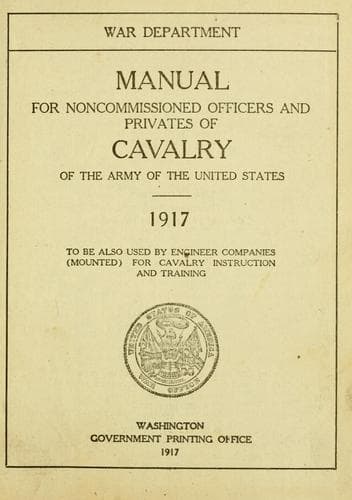
Manual for Noncommissioned Officers and Privates of Cavalry of the Army: of the United States 1917. To be also used by Engineer Companies (Mounted) for Cavalry Instruction and TrainingUnited States. War Department
History
Manual for Noncommissioned Officers and Privates of Cavalry of the Army: of the United States 1917. To be also used by Engineer Companies (Mounted) for Cavalry Instruction and Training
United States. War Department
United States. Army -- Handbooks, manuals, etc.
=665.= To create a correct appreciation of the requirements of fire
discipline, men are taught that the rate of fire, having constantly in
view the available ammunition supply, should be as rapid as is
consistent with accurate aiming; that the rate will depend upon the
visibility, proximity, and size of the target; and that the proper
rate will ordinarily suggest itself to each trained man usually
rendering cautions or commands unnecessary.
=666.= In attack, ammunition must be used with extreme caution in
order that the highest rate of fire may be employed at the halt
preceding the assault and in pursuing fire.
=667.= In defense, when the target disappears behind cover, platoon
leaders suspend fire, prepare their platoons to fire upon the point
where it is expected to reappear, and greet its reappearance instantly
with a vigorous burst of fire. In defense the available ammunition
supply is not ordinarily so limited as in the attack.
=668.= For communication between the firing line and the reserve or
commander in rear certain signals are prescribed (par. 997). In
transmission their concealment from the enemy's view should be
insured. In the absence of signal flags the headdress or other
substitute may be used.
RANGES.
=669.= For convenience of reference, ranges are classified as follows:
0 to 600 yards, close range.
600 to 1,200 yards, effective range.
1,200 to 2,000 yards, long range.
Over 2,000 yards, distant range.
The distance to the target must be determined as accurately as
possible and the sights set accordingly.
Aside from training and morale, this is the most important single
factor in securing effective fire at the longer ranges.
Except in a deliberately prepared defensive position, the most
accurate and only practicable method of determining the range, in
absence of a suitable mechanical range finder, will generally be to
take the mean of several estimates made independently.
_Estimation of ranges._--Five or six officers and men, selected from
the most accurate estimators in the troop and designated as _range
estimators_, should be specially trained in estimating distances.
Whenever necessary and practicable, the captain assembles the range
estimators, points out the target to them, and adopts the mean of
their estimates. The range estimators then take their customary posts.
When a range is announced, the men at once set their sights to
correspond, and whenever practicable an examination of the pieces is
made in order to verify the sight setting.
(_C. C. D. R., No. 1, Apr. 26, 1917._)
Public-domain text, read in full here on John Shaqi.
Reviews
Reviews
No reviews yet
Be the first to share your thoughts on this work.
Elsewhere in the archive
Join the Discussion
Join the discussion
Sign in to leave a comment or review.
Sign InorCreate an account