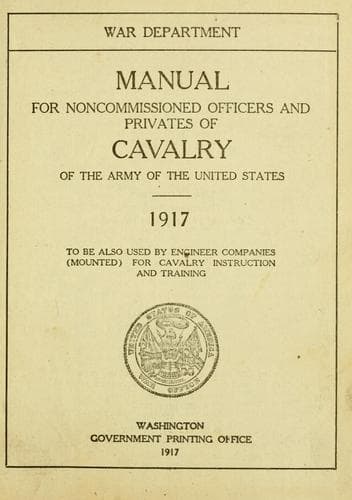
Manual for Noncommissioned Officers and Privates of Cavalry of the Army: of the United States 1917. To be also used by Engineer Companies (Mounted) for Cavalry Instruction and TrainingUnited States. War Department
History
Manual for Noncommissioned Officers and Privates of Cavalry of the Army: of the United States 1917. To be also used by Engineer Companies (Mounted) for Cavalry Instruction and Training
United States. War Department
United States. Army -- Handbooks, manuals, etc.
Firing is delayed as long as possible for three reasons, viz: (_a_) At
the extreme ranges little damage can be done on the enemy, and
ineffective firing always encourages him; (_b_) halting to fire delays
the advance, and the great object to be accomplished is to close in on
the enemy where you can meet him on better terms; (_c_) plenty of
ammunition will be required at the decisive stage of the fight, and it
is very difficult to send extra ammunition up to the firing line.
=Therefore never fire until ordered to do so, and then never fire more
than the number of rounds designated. Never fire after the command
"cease firing" is given.=
Ammunition in the bandoleers will ordinarily be expended first. Thirty
rounds in the right pocket section of the belt will be held as a
reserve, to be expended only when ordered by an officer.
Soon, however, it will be necessary to halt and open fire on the enemy
in order to cause him some loss, to make his riflemen keep down in
their trenches, and to make them fire wildly. It is probable that at
this time and until you arrive much closer you will not see any of the
enemy to fire at. You may not even see any trenches nor know just
where the enemy is. Your higher officers, however, with their field
glasses and the messages they receive, will know. Each troop will be
assigned a certain front to cover with its fire. =Therefore be careful
to fix your sights at the designated range and fire only at the
designated target.= This means team work in firing, which is one of
the most important elements of success.
The firing line advances from position to position by means of rushes.
At long range the entire line may rush forward at the same time, but
as the range decreases one part of the line rushes forward while the
remainder keeps up a hot fire on the enemy. The number taking part in
each rush decreases as the fire of the enemy becomes warmer, until
perhaps only one squad, or even less, rushes or crawls forward at a
time, protected by the fire of the rest of the company. The distance
covered by each rush also becomes less and less. After any rush no
part of the line again advances until the rest of the line is up. =In
making a rush, the leader of the unit gives the signal and leads the
way. The rest follow. No attempt is made to keep a line, but each man
rushes forward at a run, seeking only to reach the new halting
position as quickly and with as little exposure as possible.= When
halted, the skirmishers need not be in a perfect line, but every
advantage should be taken of the ground for concealment and
protection. It is necessary only that no man or group of men should
interfere with the fire of other parts of the firing line.
Public-domain text, read in full here on John Shaqi.
Reviews
Reviews
No reviews yet
Be the first to share your thoughts on this work.
Elsewhere in the archive
Join the Discussion
Join the discussion
Sign in to leave a comment or review.
Sign InorCreate an account