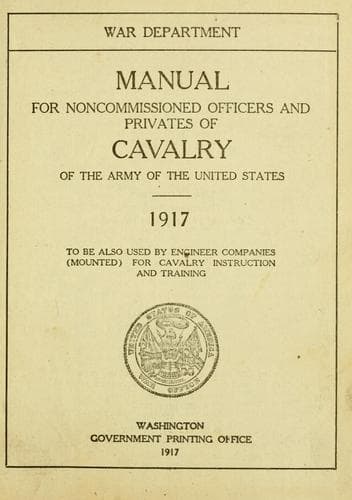
Manual for Noncommissioned Officers and Privates of Cavalry of the Army: of the United States 1917. To be also used by Engineer Companies (Mounted) for Cavalry Instruction and TrainingUnited States. War Department
History
Manual for Noncommissioned Officers and Privates of Cavalry of the Army: of the United States 1917. To be also used by Engineer Companies (Mounted) for Cavalry Instruction and Training
United States. War Department
United States. Army -- Handbooks, manuals, etc.
The noise on the firing line will be great. Leaders will be disabled
and new men will take their places. Reinforcements coming up will
cause units to become mixed. To the green man everything may appear to
be in confusion, but this is not so. This is war as it really is. =If
you have lost your section or your section leader, join the leader
nearest to you.= This is the way the game is played.
As long as the fight lasts every available rifleman must be kept in
the firing line. The first and last consideration is to win the
battle. =Therefore, under no circumstances will any soldier be
permitted to go to the rear, either for ammunition or to assist the
wounded.=
If the attacking force can no longer advance, it is much safer to
throw up hasty intrenchments and await the arrival of reinforcements
or darkness than it is to retreat. Retreating troops are the ones that
suffer the greatest. This lesson is taught by every great war.
=Therefore, always remember that the safest thing to do is to stick to
the firing line.=
Troops on the firing line, when not actually engaged in firing at the
enemy, busy themselves throwing up shelter trenches. It only requires
a few minutes to construct a trench that gives great protection.
=Therefore, never get separated from your intrenching tool.=
Concealment is no less important than protection. Therefore, when
conditions permit, as is generally the case when on the defensive,
every effort should be made to hide intrenchments by the use of sod,
grass, weeds, bushes, etc.
In making an attack the infantry is always supported when possible by
its own artillery, which continues to fire over its head until the
infantry arrives very close to the enemy's trenches. This fire is
helping you a great deal by keeping down the fire of the enemy's
infantry and artillery. Therefore, don't think you are being fired
into by your own artillery because you hear their shells and shrapnel
singing through the air or bursting a short distance in your front,
but rather be thankful you are receiving their help up to the very
last minute.
In the last rush which carries the enemy's position there is always
much mixing of units. The firing line does not continue rushing madly
as individuals after the enemy, but halts and fires on him until he
gets out of good range. The pursuit is taken up by formed troops held
in reserve or by the firing line only after its units are again gotten
together.
As the fighting often lasts all day, and great suffering is caused
from thirst, =don't throw away your canteen when the fight commences=.
It may also be impossible to get rations up to the line during the
night. =Therefore, it is advisable to hold onto at least one ration.=
As the recent war has shown the possibility of hand-to-hand fighting,
especially at night, each soldier should be schooled in the use of the
bayonet.
The following has particular reference to the duties of platoon and
section leaders and to the teamwork of the platoon in combat:
Public-domain text, read in full here on John Shaqi.
Reviews
Reviews
No reviews yet
Be the first to share your thoughts on this work.
Elsewhere in the archive
Join the Discussion
Join the discussion
Sign in to leave a comment or review.
Sign InorCreate an account