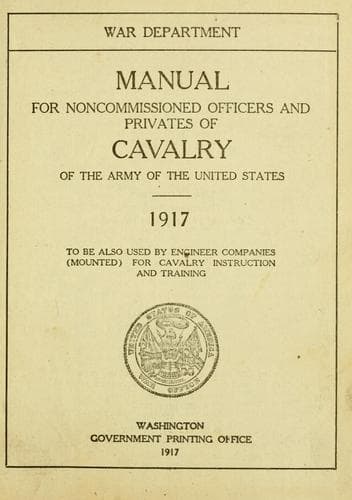
Manual for Noncommissioned Officers and Privates of Cavalry of the Army: of the United States 1917. To be also used by Engineer Companies (Mounted) for Cavalry Instruction and TrainingUnited States. War Department
History
Manual for Noncommissioned Officers and Privates of Cavalry of the Army: of the United States 1917. To be also used by Engineer Companies (Mounted) for Cavalry Instruction and Training
United States. War Department
United States. Army -- Handbooks, manuals, etc.
Attacking troops must first gain =fire superiority= in order to reach
the hostile position. By gaining fire superiority is meant making
one's fire superior to that of the enemy in volume and accuracy, and
it depends upon the number of rifles employed, the rate of fire, the
character of the target, training and discipline, and fire direction
and control. When the fire of the attackers becomes effective and
superior to that of the defenders the latter are no longer able to
effectively and coolly aim and fire at the former, and, as a
consequence, the attackers are able to inaugurate a successful rush or
advance which carries them nearer to the enemy's position.
When a trained organization has been committed to the attack, the
gaining of fire superiority depends upon the way in which =fire
direction= and =fire control= are exercised.
The captain =directs= the fire of the troop. He indicates to the
platoon commanders the target (enemy) which the troop is to fire and
advance upon, and tells each upon which part of this target he is to
direct the fire of his platoon. When he desires the fire to be opened,
he gives the necessary commands or signals, including the range at
which the sights are to be set.
When the fire fight has once started, it becomes to a great extent a
fight of a number of platoons. The platoon is the largest organization
which can be controlled by a single leader in action. The platoon
commander (lieutenant or sergeant) =controls= its fire in order to
gain the maximum fire effect and to avoid wasting ammunition. He must
try his best to make the fire of his platoon effective, to get it
forward, and to support neighboring platoons in their effort to
advance. At the same time he must hold himself subject to his
captain's directions. He should take advantage of every chance to
carry his platoon forward unless otherwise ordered. In all this he is
assisted by his section chiefs (sergeants) and by his corporals.
At the commencement of an engagement the platoon commander will give
the objective (part of the enemy's line or aiming target) at which his
platoon is to direct its fire. Noncommissioned officers must be sure
that they see and understand the objective, and that all the men in
their squads do likewise. Fire is then directed at this objective
without further command until the platoon commander gives a new
objective.
Men should be instructed to aim at that part of the target assigned to
their platoon which corresponds with their own position in their own
platoon, so that there will be no portion of the target which is not
covered by fire. A portion of the enemy's line not covered by fire
means that that portion is able to coolly aim and fire at their
opponents.
Public-domain text, read in full here on John Shaqi.
Reviews
Reviews
No reviews yet
Be the first to share your thoughts on this work.
Elsewhere in the archive
Join the Discussion
Join the discussion
Sign in to leave a comment or review.
Sign InorCreate an account