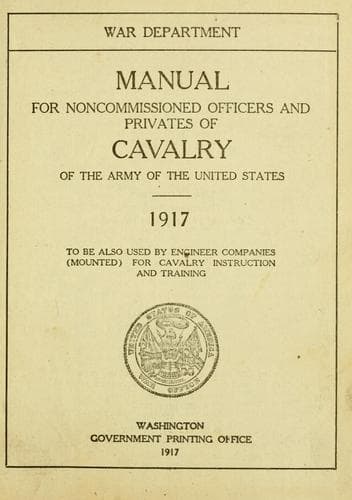
Manual for Noncommissioned Officers and Privates of Cavalry of the Army: of the United States 1917. To be also used by Engineer Companies (Mounted) for Cavalry Instruction and TrainingUnited States. War Department
History
Manual for Noncommissioned Officers and Privates of Cavalry of the Army: of the United States 1917. To be also used by Engineer Companies (Mounted) for Cavalry Instruction and Training
United States. War Department
United States. Army -- Handbooks, manuals, etc.
In an engagement the voice can seldom be heard over a few feet, and
the platoon commander will generally have to convey his orders by
signals. A sergeant may be able to shout orders to his section, and
orders may be repeated along a skirmish line by shouting. Care should
be taken that orders intended for one platoon only are not thus
conveyed to another platoon.
A short blast on the whistle, given by the platoon commander, means
"Attention to Orders." All noncommissioned officers at once suspend
firing and glance toward the platoon commander to see if the latter
has any signals or orders for them. If not, they resume firing. A long
blast on the whistle means "Suspend Firing." When a noncommissioned
officer hears this signal from his platoon commander, he should at
once shout "Suspend Firing." Upon receiving a signal, the
noncommissioned officer for whom it is intended should at once repeat
it back, to be sure that it is correctly understood.
As a rule, rushes should be started by a unit on one flank and should
be followed in succession by the other units to the opposite flank.
Each succeeding unit should halt on the line established by the unit
which first rushed. When a unit is about to rush, leaders in charge of
adjacent units should caution their men to be careful not to fire into
the rushing unit as it bounds forward.
When one unit suspends fire for the purpose of rushing, adjacent
leaders should arrange to have a portion of their men turn their fire
on the target of the rushing unit, to the end that there may be no
portion of the enemy's line not under fire and able to fire coolly on
the rushing unit.
Rushes should be made for as long a distance as possible, due regard
being had for the wind of the men and not to get beyond supporting
distance of the other units. Long rushes facilitate an advance, and
quickly place a skirmish line close to the enemy's position, where
its fire will have more effect. An attacking line suffers less from
casualties at short ranges than it does at mid range.
Every advantage should be taken to utilize the cover available. The
best kind of cover is that which, while it masks the skirmishers from
the sight and fire of the enemy, affords favorable conditions for
firing and for readily advancing. In order to allow men to regain
their wind, or should the fire of the enemy be so effective as to
prevent a further advance without reinforcement, advantage may be
taken to lie close in cover, or hasty fire trenches may be thrown up
in order to allow the line to maintain its position. "=To go back
under fire is to die.="
Public-domain text, read in full here on John Shaqi.
Reviews
Reviews
No reviews yet
Be the first to share your thoughts on this work.
Elsewhere in the archive
Join the Discussion
Join the discussion
Sign in to leave a comment or review.
Sign InorCreate an account