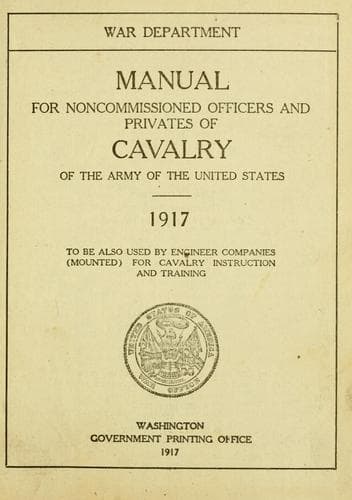
Manual for Noncommissioned Officers and Privates of Cavalry of the Army: of the United States 1917. To be also used by Engineer Companies (Mounted) for Cavalry Instruction and TrainingUnited States. War Department
History
Manual for Noncommissioned Officers and Privates of Cavalry of the Army: of the United States 1917. To be also used by Engineer Companies (Mounted) for Cavalry Instruction and Training
United States. War Department
United States. Army -- Handbooks, manuals, etc.
When a platoon is firing, all noncommissioned officers watch every
opportunity to make the fire more effective. The section chiefs and
corporals should constantly watch the men to see that they do not
become excited, fire too hastily or without aim, that their sights are
set at the correct range, that they are obviously firing at the
designated target, and that they assume steady firing positions and
take advantage of cover. In performing these duties it may be
necessary for the section chiefs to be constantly crawling along the
line. A substitute chief assists the chief of his section by
supervising the fire of the men near him, firing when not actively
engaged in that duty.
Bayonets are fixed preparatory to a charge when armed with that
weapon. This command is usually given by the bugle. Only two or three
men in each section should fix their bayonets at the same time, in
order that there may be no marked pause or diminution in the fire at
this critical stage of the engagement.
In order to be effective in combat, the platoon must be thoroughly
trained to work as a team. Each noncommissioned officer must be
conversant with the signals and commands and the proper methods for
instantly putting into effect the orders of his platoon commander.
Each private must be trained until he instinctively does the right
thing in each phase of the action.
=Section 3. Patrolling.=
The designation of a patrol indicates the nature of the duty for which
it is detailed, as, for example, visiting, reconnoitering, exploring,
flanking, combat, harassing, pursuing, etc. An Infantry patrol
consists, as a rule, of from 3 to 16 men, a Cavalry patrol generally
of from 4 to 10 men.
Reconnoitering patrols are habitually small and seek safety in
concealment or flight, fighting only when their mission demands it.
The most skillful reconnoissance is where patrols accomplish their
mission and return without being discovered by the enemy. When
resistance is expected stronger detachments are required. These cover
themselves with small patrols of two to four men, the remainder acting
as support.
The commander determines the number and strength of patrols and when
they are to be sent out. It is a cardinal principle to send out
patrols of such strength only as will accomplish the object.
Public-domain text, read in full here on John Shaqi.
Reviews
Reviews
No reviews yet
Be the first to share your thoughts on this work.
Elsewhere in the archive
Join the Discussion
Join the discussion
Sign in to leave a comment or review.
Sign InorCreate an account