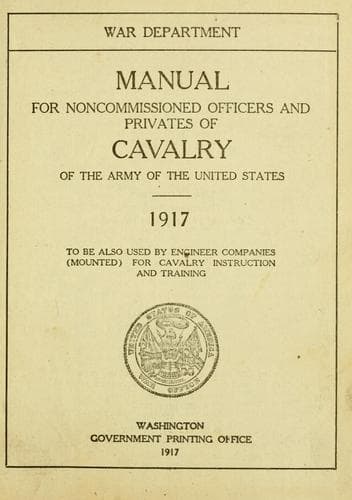
Manual for Noncommissioned Officers and Privates of Cavalry of the Army: of the United States 1917. To be also used by Engineer Companies (Mounted) for Cavalry Instruction and TrainingUnited States. War Department
History
Manual for Noncommissioned Officers and Privates of Cavalry of the Army: of the United States 1917. To be also used by Engineer Companies (Mounted) for Cavalry Instruction and Training
United States. War Department
United States. Army -- Handbooks, manuals, etc.
The officer sending out the patrol verifies the details, designates a
second in command, and gives the necessary instruction. The orders or
instructions for a patrol, or for any detachment going on
reconnoissance, must state clearly where the enemy is or is supposed
to be, what information is desired, what features are of special
importance, the general direction to be followed, whether friendly
patrols are liable to be encountered, and where messages are to be
sent or the patrol is to report. Important and comprehensive
instructions should be in writing, but precautions against capture of
papers must be taken. An officer sending out a patrol must be certain
that his orders are understood. Detailed instructions are, as a rule,
avoided. When necessary the time of return is stated.
The patrol leader should be selected with care. He should be an
excellent horseman, have good judgment, courage, be able to read maps,
make sketches, and send clear and concise messages. In addition to his
ordinary equipment, he should have a map of the country, a watch,
field glass, compass, whistle, message blanks, and pencils.
The leader of a patrol should carefully inspect the men and horses
before starting out. He should see that the horses are well shod and
in good working condition. Nervous horses or those that neigh when
left alone should not be taken. The equipment of each man should be
complete and so arranged as to prevent rattling. Articles that are
liable to glitter in the sunlight should be covered. Nothing should be
taken along that would be of information to the enemy if any members
of the patrol were captured, for example, copies of orders, maps with
positions of troops marked thereon, letters, newspapers, or collar
ornaments.
The leader then gives his patrol information and instructions. These
embrace instructions from higher authority; his detailed plans;
information of the country and enemy; the countersign, if any; the
point where the patrol will assemble if scattered. He will see that
the men understand the prescribed signals.
=It must always be remembered that it makes no difference, how
valuable may be the information that the patrol gets, it is worthless
if not sent back in time to be of service.= Herein is where most
patrols fail. This applies particularly to the information obtained by
patrols acting as a point or flankers of advance, rear, and flank
guards. Whenever the patrol gets any information, the leader must
think whether the commanding officer would change his plans or issue
new orders if he had the information. If he would, the information
should be sent back at once. If the distance is great or the
inhabitants are hostile, it is well to send two men with the message.
These men should not travel side by side, but as a patrol of two men.
If the information is very important, and the danger of capture is
considerable, the message should be sent by two parties, each
traveling by a different route. The gaits should be specified.
Public-domain text, read in full here on John Shaqi.
Reviews
Reviews
No reviews yet
Be the first to share your thoughts on this work.
Elsewhere in the archive
Join the Discussion
Join the discussion
Sign in to leave a comment or review.
Sign InorCreate an account