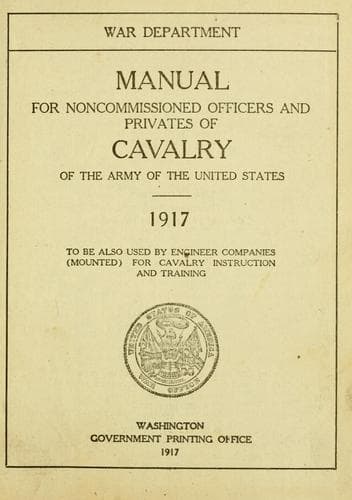
Manual for Noncommissioned Officers and Privates of Cavalry of the Army: of the United States 1917. To be also used by Engineer Companies (Mounted) for Cavalry Instruction and TrainingUnited States. War Department
History
Manual for Noncommissioned Officers and Privates of Cavalry of the Army: of the United States 1917. To be also used by Engineer Companies (Mounted) for Cavalry Instruction and Training
United States. War Department
United States. Army -- Handbooks, manuals, etc.
A message from a patrol should always show (_a_) the place from which
it is sent; (_b_) the time it is sent (date, hour, and minute); (_c_)
to whom it is sent; (_d_) the message itself; (_e_) what the patrol
intends doing after sending the message; (_f_) the name of the sender.
Under (_d_) care must be taken to separate what has actually been seen
by the patrol from information received from other sources. Care must
also be taken not to exaggerate what is seen, but to report only the
exact facts.
Whether moving or halted, patrols exercise the greatest vigilance to
prevent discovery. No formal formation is or should be prescribed.
Under the leader's guidance it moves so as to guard against surprise,
usually with point and flankers. To extend the sphere of its
observation, still smaller patrols (one or two men) may be sent out
for short distances, communication with the leader being maintained by
signals. Whatever the formation adopted, it should favor the escape of
at least one man in case of surprise.
In patrols of two to five men the commander generally leads. In this
formation few signals are necessary, the men simply regulating their
movements by his.
In questioning civilians caution is observed not to disclose
information that may be of value to the enemy. Strangers are not
allowed to precede the patrol. Patrol leaders are authorized to seize
telegrams and mail matter, and to arrest individuals, reporting the
facts as soon as possible.
Patrols should observe everything for signs of the enemy. Even
apparent trifles may be of great value. The finding of a collar
ornament showing a man's regiment may enable the chief of staff to
determine that the enemy has been reenforced.
Patrols should not travel on the main roads if they can observe them
and at the same time make the necessary progress by moving some
distance to the side of the roads.
Except in case of attack or of great personal danger, no member of the
patrol should fire on hostile troops without orders from the patrol
leader. When sent out to gain information, patrols should avoid
fighting unless it is absolutely necessary in order to carry out their
orders. If the leader determines to fight, he should quickly decide
whether he will attack mounted with the saber and thus dispose pf the
enemy without the noise of fire action. Cases will arise where a quick
mounted pistol attack will obtain the best results. If discovered, the
patrol would dismount only as a last resort. The leader should always
have in mind, as he rides long, what he will do if he meets the enemy.
Villages and inclosures involving danger of surprise are entered with
precaution, and for brief periods only. Halts are made at points
affording good view, and the country is studied in all directions,
landmarks to the rear being impressed on the minds of the men so that
the way back can be readily found; the leader consults his map and
locates himself thereon.
Public-domain text, read in full here on John Shaqi.
Reviews
Reviews
No reviews yet
Be the first to share your thoughts on this work.
Elsewhere in the archive
Join the Discussion
Join the discussion
Sign in to leave a comment or review.
Sign InorCreate an account