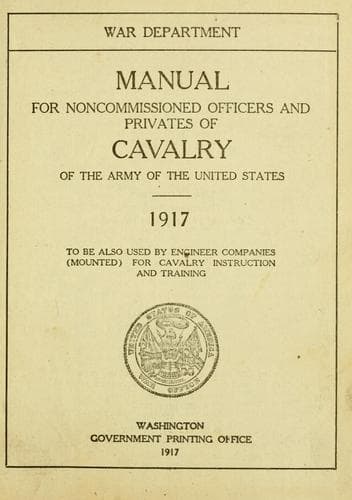
Manual for Noncommissioned Officers and Privates of Cavalry of the Army: of the United States 1917. To be also used by Engineer Companies (Mounted) for Cavalry Instruction and TrainingUnited States. War Department
History
Manual for Noncommissioned Officers and Privates of Cavalry of the Army: of the United States 1917. To be also used by Engineer Companies (Mounted) for Cavalry Instruction and Training
United States. War Department
United States. Army -- Handbooks, manuals, etc.
When a patrol is scattered it reassembles at some place previously
selected; if checked in one direction, it takes another; if cut off it
returns by a detour or forces its way through. As a last resort it
scatters so that at least one man may return with information. Patrols
nearing their own lines should march at a walk unless pressed by the
enemy.
Occasionally it is advisable for the leader to conceal his patrol and
continue the reconnaissance with one or two companions.
Patrols far from their commands or in contact with the enemy often
remain out overnight. In such cases they seek a place of concealment,
proceeding thereto after nightfall or under cover.
When the enemy is encountered it is very necessary to locate his main
force. Information is particularly desired of his strength, whether he
has infantry, cavalry, and artillery, the route and direction of his
march, or the location of his camp and line of outposts.
Dust clouds indicate moving bodies. Infantry raises a low, thick
cloud; cavalry a high, thin cloud; artillery and wagons a broken
cloud. The kind of troops, direction of march, and approximate
strength may thus sometimes be roughly estimated. If from some
position a body of troops can be seen marching along in column, the
exact time in minutes and seconds it requires for them to pass a
certain point should be noted, together with the formation they are
in, thus: Infantry, column of squads, three minutes and twelve
seconds; cavalry, columns of twos at a trot, one minute and twenty
seconds; wagons, four-mule, five minutes. From this information the
strength can be determined by the following rule:
Assuming that infantry in column of squads occupy half a yard per man,
cavalry in column of fours 1 yard per man, and artillery and wagons in
single column 20 yards per gun, caisson, or wagon, a given point would
be passed in one minute by about--
175 infantry.
110 cavalry at a walk.
200 cavalry at a trot.
5 guns, caissons, or wagons.
For troops in column of twos, take one-half of the above estimate.
Patrols should always observe the country marched over, with a view to
making a report on the same. The following information is always of
value:
=Roads.=--Direction; kind, whether dirt, gravel, macadam, etc.;
width, whether suitable for column of squads, etc.; border, whether
fenced with stone, barbed wire, rails, etc.; steepness in crossing
hills and valleys; where they pass through defiles and along
commanding heights, etc.; crossroads.
=Surrounding country.=--Whether generally open and passable for
infantry, cavalry, and artillery, or whether broken and impassable,
due to fences, woods, crops, ravines; whether good grazing is
available, etc.
=Railroads.=--Single or double track, narrow or broad gauge, tunnels,
bridges, cuts, direction, stations, etc.
=Bridges.=--Material, wood, stone, steel, etc.; length and breadth;
number and kind of piers or supports.
Public-domain text, read in full here on John Shaqi.
Reviews
Reviews
No reviews yet
Be the first to share your thoughts on this work.
Elsewhere in the archive
Join the Discussion
Join the discussion
Sign in to leave a comment or review.
Sign InorCreate an account